
Recycling multi-tonnage waste from the local manufacturing for secondary use in road construction
As a resource-saving alternative, expanding the use of Bashkortostan's high-tonnage waste in road construction through the introduction of environmentally friendly recycling technologies remains an urgent task. This article is aimed at the study of the secondary use of binders based on high-tonnage soda production waste and blast furnace slag to strengthen the soil foundations during the construction of highways. The highways M-5, M-7, M-12 of the transport infrastructure connect Ufa with Moscow, Kazan, Perm, Ekaterinburg, Chelyabinsk, Orenburg (Р-240) and Samara. Reliable operational performance of highways is determined by the construction of a durable and time-stable foundation. Multi-tonnage waste from regional enterprises: sludge, ash and slag waste, slags, etc. have potential recycling opportunities in road transport construction. The following raw materials were used as the initial raw materials of the binder: lime-containing soda production waste from the Bashkir Soda Company (Sterlitamak) and blast furnace slag from the Chelyabinsk Metallurgical Combine (Chelyabinsk). It has been established that the required amount of lime-slag binder for strengthening dispersed clay and sandy loam soils is 8-10% of the dry soil mass. The supramolecular mechanism of soil hardening with lime-slag binders begins quickly enough and lasts for several weeks, resulting in an increase in compressive strength by 27%. Innovative recycling technologies for the use of high-tonnage waste in road transport construction have been successfully tested in strengthening the foundations of highways.
road building, transport infrastructure, high-tonnage waste, recycling.
Motorways have a significant impact on the efficiency of the functioning of the economy of the constituent entities of the Russian Federation. In order to solve the demanded tasks of increasing the durability of roads and transport infrastructure, as well as to improve the operational performance of highways, it is necessary to ensure the quality of the construction of a durable and time-stable foundation and roadbed. Expanding the use of high-tonnage waste from the regional industry of the Republic of Bashkortostan [1] in environmentally friendly recycling technologies in road construction remains an urgent task.
The purpose of this article is to study the possibilities of reuse of binders based on high–tonnage soda production waste and blast furnace slag to strengthen the soil foundations during the construction of highways.
The relevance of using reinforced soils is currently due to the increasing volume of highway construction, as well as the shortage and high cost of transporting stone materials. In most of the Eastern European territory of Russia, there are insufficient reserves of high-quality stone materials, and intensive road construction is based on the transportation of crushed stone delivered from mountainous parts of the country over a distance of up to 400-500 km. Transportation costs for the delivery of crushed stone can be a significant part (up to 30-40%) of the cost of durable stone materials. In road construction, the processing of low-strength carbonate rocks with special compositions (for example, sulfur melt) is being introduced to obtain high-strength material. Significant costs in the transportation of conditioned building materials cause an increase in the total cost of building highways, and therefore it is advisable to use local materials reinforced with various binding compositions for the construction of roadways in these territories [2, 3].
Bashkortostan’s economic and geographical position in the Russian Federation is determined by its unique location at the junction of Europe and Asia. The Republic of Bashkortostan borders the Perm territory and the Sverdlovsk region from the north; the Chelyabinsk region, large industrial regions of the Urals, adjoins from the east. The Orenburg region is located on the southern, southwestern and southeastern borders, and the Republic of Tatarstan, the largest industrial region of the Volga region, is its western neighbor (Figure 1).
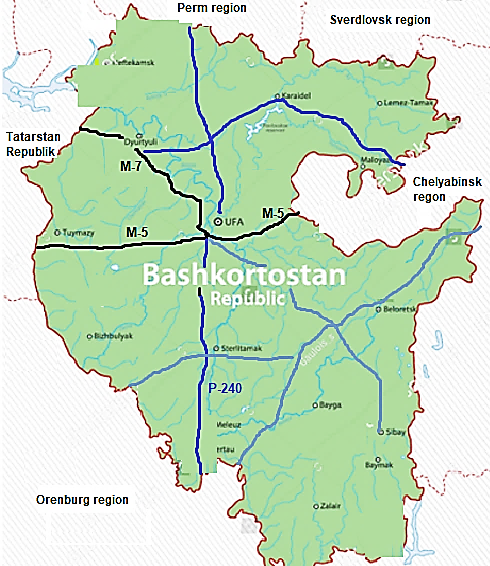
Figure 1. The most important highways of Bashkortostan
The highways of the transport infrastructure connect Ufa, the capital of the republic, with Moscow, Perm, Yekaterinburg, Chelyabinsk, Orenburg, Samara and Kazan. The federal highway M-5 “Ural” runs along the southern outskirts of the city, and the federal highway M-7 “Volga” ends here. The “P-240” Ufa-Orenburg highway begins in the southern direction from Ufa, which connects the megacity with the international airport. Communication with the cities and districts of the Republic of Bashkortostan and the nearest neighbors is maintained by bus transportation.
The total length of public roads in the territory of the Republic of Bashkortostan is more than 63 thousand km, of which:
– federal highways of high-speed transport infrastructure M-5, M-7, M-12 – 952 km;
– highways of regional or inter–municipal (inter–district) significance – more than 15 thousand km;
— highways of local significance – about 48 thousand km. There are also about 8000 km of non-state roads in the region, which are mainly assigned to “Rosneft-Bashneft”.
As part of the renovation of Bashkortostan’s road transport infrastructure, reconstruction of the bypass of settlements in Ilishevsky and Dyurtyuli districts was completed in 2025: Isametovo, Verkhnearkeyevo, Ishkarovo, and Asyanovo (68 km in total) on the M-7 “Volga” and M-12 “Vostok” highways. In 2026, reconstruction is planned to be completed on sections of the M-5 “Ural” highway (km 1280-1300; km 1300-1312; km 1375-1401) and M-7 (km 1310+910; km 1321+500; km 1231+52 – km 1251+773). In 2027-2028, the reconstruction of the M-5 section at the entrance to the city of Ufa (km 0+410 – km 0+750) will be carried out.
It should be noted that as part of the implementation of the national project «Infrastructure for Life», the installation of acoustic noise barriers and bus stops on the P-240 Ufa-Orenburg highway is envisaged. The Republican road construction program for 2025-2030 includes, in addition to the construction and repair of roads between settlements, the reconstruction of road bridges and overpasses, the installation of energy-efficient lighting, the repair of culverts, and the organization of weight control points.
Reliable operational efficiency of highways is determined by the construction of a durable and time–stable foundation and roadbed [4, 5]. The roadbed is a geotechnical structure in the form of an embankment or excavation, which provides the spatial location of the road and serves as a foundation for asphalt pavement. The road surface traditionally includes the following elements: the upper part of the road surface (working layer); the body of the embankment (with sloping parts); the base of the embankment; the base and sloping parts of the excavation; culverts and devices for surface drainage and lowering or discharging groundwater (drainage); protective geotechnical devices and structures designed to protect the earth bed from dangerous destructive factors (erosion, landslides, etc.).
Technologies for strengthening soil embankments and foundations of highways are aimed at increasing the durability of the functioning of the roadway; currently, a large number of different methods have been proposed [6] to strengthen the soil of the roadway. The most common soils of the Volga region and the Urals include clay dispersed soils, the negative feature of which is a sharp decrease in their physical and mechanical characteristics when moistened, which significantly reduces the possibility of their use in road construction. It should be noted that there is a particular danger of intense flooding in floodplain areas where highways are located on ground foundations composed of alluvial deposits (silts, floating sands and loams), which belong to weak dispersed soils. Therefore, under unfavorable soil and hydrological conditions, it is necessary to develop special recycling technologies using innovative methods during the construction of highways and transport infrastructure.
To increase the bearing capacity and reduce deformations of the soil foundations of motorways, there are various methods of geotechnical soil reinforcement [7, 8]. The choice of a method for strengthening the soil foundations of the roadway and embankments is primarily determined by the type of soil in the natural zone of the region, the level of groundwater, etc. Many different methods are conditionally divided into: mechanical (placing in the thickness of the road surface canvases of reinforcing components); physical (strengthening of the soil mass of the bases by means of thermal fixation, freezing-thawing, electroosmosis, etc.); chemical (improvement of soil properties by treatment with complementary special additives).
High-quality construction and long-term operation of highways on clay dispersed soils is actually carried out by strengthening the foundations of the roadway with various technologies: stabilization and stability due to the physico-chemical interaction of additives and reagents introduced into the soil. In recent years, complex methods of strengthening weak soils have been developed using binders, various stabilizers, and synthetic resins, which can significantly increase the water resistance and strength characteristics of reinforced soils.
Today, among the industrial wastes of Bashkortostan, the most environmentally unfavorable are considered to be the accumulated waste from machine-building and chemical plants, the metallurgical industry, etc. A significant amount of multi-tonnage waste from regional industrial enterprises consists of sludge, ash and slag waste, slags, etc., which have the potential to be used as secondary resources to expand the raw material base of regional road construction.
Large-scale waste is similar in chemical composition to natural raw materials of regional production, which determines the prospects of using these wastes instead of natural materials in the innovative production of building materials. However, manufacturers of building materials currently make insufficient use of the secondary resource potential of high-tonnage waste by recycling technology in the manufacture of building materials, preferring natural ecosystem raw materials. This happens due to a number of economic, technological and other reasons, which leads to the placement of non-recyclable industrial waste in storage dumps [9].
In order to reduce the anthropogenic impact of industrial technogenic sludge accumulators on the environment, it is necessary to introduce the direction of recycling technologies for the use of multi-tonnage waste from the region in road transport construction and thereby create favorable conditions for the targeted management of the natural and technical system of anthropogenic landscapes. Newly developed waste disposal technologies should comply with the fundamental principles of sustainable development of human civilization, which make it possible to maximize the resource potential of large-scale waste in economic turnover [10, 11].
When assessing the possibility of using secondary resources to expand the raw material base of the construction industry of the Republic of Bashkortostan, only those resources based on inorganic non-hazardous (hazard class V) multi-tonnage waste from industrial enterprises with relative uniformity of chemical composition and physico-mechanical properties, suitable without additional neutralization and purification for use in road transport construction by recycling technology, were considered. A potential list was compiled (in addition to soda production waste, phosphogypsum, ash and slag) of secondary resources based on large-tonnage waste from industrial enterprises in Bashkortostan and neighboring regions that are in demand for innovative technologies in road construction.
The production of soda ash at the “Bashkir Soda Company” (Sterlitamak), launched in 1951, is accompanied by the formation of a large amount of high-tonnage waste in the form of alkaline finely dispersed sludge [12, 13]. For 1 ton of soda ash, 8-10 m3 of sludge containing 200-250 kg of solid phase is accounted for; these wastes are drained into special slurry basins, where solid particles are deposited. The sludge storage facilities of the “Bashkir Soda Company” are located on the banks of the Belaya River in the Republic of Bashkortostan, consist of 10 compartments, cover an area of more than 470 hectares, which form the «white seas» (Figure 2). It should be noted that local clay rocks were used as an anti-filtration screen at the facility, and during long-term operation of clay screens, permeability increases significantly under the influence of brines [14].
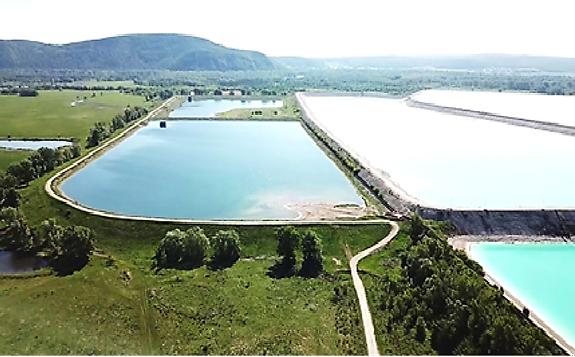
Figure 2. Sludge accumulators of the “Bashkir Soda Company”
(aerial photography, Sterlitamak)
Tens of millions of tons (in terms of dry matter) of soda production waste have been accumulated in the sludge storages of the “Bashkir Soda Company”, hundreds of hectares of land have been allocated for storage. Thus, the area of the main sludge storage tank is 136 hectares at a depth of 22 m; the accumulated volume is estimated to range from 20 to 30 million tons of sludge. Currently, the Russian Federation has accumulated more than 50 million tons of soda production waste, and their number is increasing by about 1 million tons annually [15].
Based on data from X-ray phase analysis of samples of secondary resources of multi–tonnage waste from Bashkortostan and adjacent Volga-Ural regions, the following materials were selected for research as raw materials of hydraulic binders: lime-containing soda production waste from “Bashkir Soda Company” (Sterlitamak) distiller sludge dehydrated by filtration pressing after firing; blast furnace slag is a secondary resource of the “Chelyabinsk Metallurgical Combine” (Chelyabinsk). The preparation of the initial raw materials for use as part of a hydraulic lime-slag binder is carried out using the following technology: lime-containing soda production waste after firing at a temperature of 950°C is pre-crushed to a fraction of 1-5mm to obtain a lime-slag binder; then the crushed fired is mixed with powdered blast furnace slag.
The implemented recycling technology determines the high efficiency and low energy intensity of the production of lime-slag binder: approximately 50-60 kg of conventional fuel and 70-80 kW∙h of electricity are consumed for the production of 1 ton of binder, which is significantly lower than in the production of slag-portland cement. An innovative trend is a systematic approach to recycling Russia’s secondary waste by increasing recycling technologies that will allow up to 50% of recycled materials to be used in road construction by 2030.
To find the optimal amount of the developed lime-slag binder, when strengthening various types of clay dispersed and sandy loam soils, a certain amount of lime-slag binder and water was added to the soil sample. The resulting mixture was thoroughly mixed in a laboratory concrete mixer and kept in a desiccator for 6 hours to obtain reinforced soil, then samples were produced using a standard sealing device-cylinders with a diameter of 100 mm and a height of 140 mm. Samples of reinforced soil were produced in series based on soils with an additive 6%, 8%, 10%, 14% and 18% of the lime-slag binder from the mass of the dry soil. After manufacturing, the samples were kept for 28 days in a normal hardening chamber; then, after exposure, the compressive strength of the reinforced soils was determined in accordance with GOST 28570-2019.
Analytical processing of the results shows that for sandy loam soil, the increase in compressive strength is more pronounced, with the addition of a lime-slag binder of about 9%, its strength becomes equal to that of clay dispersed soil with the same dosage of the additive. With a further increase in the binder dosage, an even more accelerated increase in strength occurs (Figure 3), and with a dosage of lime-slag binder of more than 14%, clay dispersed soil becomes structurally analogous to concrete of compressive strength class B5.
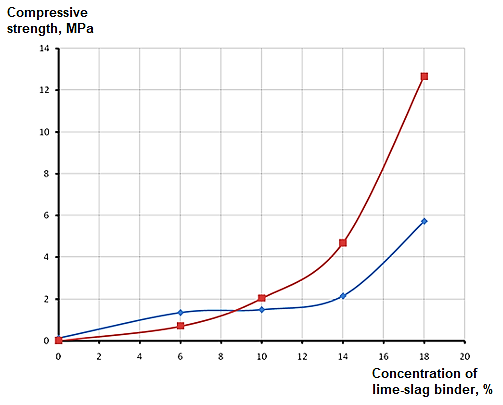
Figure 3. Results of the compressive strength test of reinforced clay and sandy loam ground samples
Based on the survey results, it was found that the minimum required amount of lime-slag binder for strengthening both dispersed clay and sandy loam soils is 8-10% of the dry soil mass, since a smaller amount of binder will not ensure stable achievement of the required compressive strength of the reinforced soil in production conditions. The following physico-chemical hardening mechanism is proposed: when lime-slag binder is mixed with water, hydration reactions of the lime-containing component and blast furnace slag first occur. The hardening of the lime-slag binder is correctly explained within the framework of fractal analysis: the catalytic effect of Ca2+, OH– and partially SO42– ions on the slag components; gypsum, actively acting on the alumina components of the slag, accelerates the hardening of the binder. Over time, nanocomposite reinforced road soils gradually harden to form sufficiently strong silicates and calcium aluminates of a fractal structure [16, 17].
It should also be noted that when treating clay soils with 8-14% (of the soil mass) lime-containing CaO additives, the components of calcium oxide interact physico-chemically with free water molecules and acquire the properties of a hydraulic binder (calcium hydroxide). Then Ca+2 cations from slaked lime migrate to the surface of aluminosilicate hydrated clay microparticles and displace interlayer water molecules with the three-dimensional formation of sufficiently durable geopolymers [18-20] based on the crystallization structure of calcium hydrosilicates and hydroaluminates (Figure 4). The physico-chemical supramolecular mechanism of strengthening stabilization begins within a few minutes and lasts for several weeks, resulting in a 27% increase in mechanical strength and water resistance of clay road foundations.
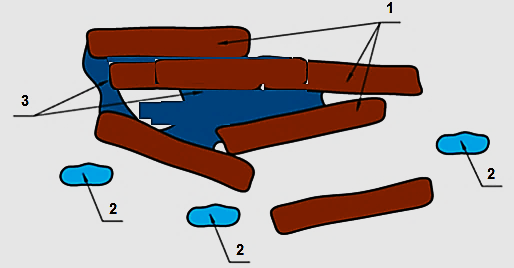
Figure 4. Supramolecular mechanism of hardening of clay soils with lime-slag binders (1 – aluminosilicate clay microparticles; 2 – calcium hydroxide;
3 – binding calcium hydrosilicates and hydroaluminates)
An assessment of the possibility of using secondary resources based on lime-slag binders to expand the raw material base of road transport construction in the Republic of Bashkortostan by recycling technology has shown that the use of composite additives to strengthen weak dispersed soils of highways is quite effective. Depending on the category of the highway, reinforced soils using recycling technologies for the use of multi-tonnage waste in road construction are used to create: lightweight road surfaces on local roads; to increase the strength of the upper part of the roadbed of the base layers on roads with heavy traffic of weighty vehicles.
It should also be noted that “Bashkir Soda Company” plans to clean soda slag accumulators by 2034 with recycling technology, then begin landscape reclamation of the territory. After the active growth of the grass cover on the reclaimed landscapes, geoecological planting of bushes and trees is planned on the site of the former sludge storage compartments. The circular economy of the 21st century is based on the expansion of the utilization of multi-tonnage waste resources through using recycling technologies in road transport construction, taking into account the regulatory framework.
Attractive into account the principles of geo-urbanism and an adequate assessment of the interests of tourism makes travel in the Volga-Ural region convenient and safe for motorists, as well as creates conditions for the development of related infrastructure of federal highways: petrol filling stations, campsites, recreation areas, etc. A complementary solution to the problems of inaccessibility and poor equipment of the transport infrastructure reduces the high cost of the route, which means it attracts tourists to picturesque landscape sites region of the Republic of Bashkortostan [21-23].
In conclusion, it can be determined that innovative recycling technologies for the use of multi-tonnage waste in road transport construction have been successfully tested in strengthening the soil foundations of highways. Reinforced ground with an addition of 8-10% lime-slag binder can be used in road structures of the lower layers of crushed stone-gravel-sand foundations.
References
1. Bedov A.I., Sinitsin D.A., Gabitov A.I. et al. Analysis and development of innovative concrete compositions in the Republic of Bashkortostan // Materials Science Forum. 2023. V. 1082. P.240-247. EDN KJUBXU.
2. Stefan Yu.V., Bondarev B.A., Yankovsky L.V. Strengthening of clay soils of roads with industrial waste and metallurgical slags // Building Materials. 2020. No.4-5. Р.80-89. EDN VHIVTH.
3. Pavlikov A.B., Kamenchukov A.V. The effectiveness of additives for soil modification // Transport facilities. 2024. V.11, No.3. EDN ACOQTF.
4. Bezrodnykh A.A., Markova I.Yu., Strokova V.V. et al. Ground concrete using a complex of binders and fly ash for road construction. Belgorod: BSTU, 2022. 122 p. EDN PNLNOA.
5. Glazachev A.O., Pavlov S.Yu., Ivanova O.V. et al. Stabilization of weak soil foundations of highways // Trends in the development of science and education. 2024. No.109-15. P.27-30. EDN IYXTMM.
6. Chudinov S.A. Improvement of soil reinforcement technology in the construction of highways. Ekaterinburg: UGLTU, 2022. 164 p. EDN LYZPVU.
7. Sonin V.V. Review of technologies for strengthening weak foundations of road // Actual problems of sciences. 2016. No.5-1. P.104-107. EDN VZEEKF.
8. Ivanova O.V., Glazachev A.O., Pavlov S.Yu. et al. The application of artificial intelligence in traffic management of the M-12 motorway // Prospects for the development of technologies: Collection of the 3rd All-Russian Conference. Voronezh: Publ. "Universit. the Book", 2025. P.167-170. EDN FXSQLT.
9. Ignatieva M.N., Yurak V.V., Dushin A.V. et al. Technogenic mineral formations: problems of transition to a circular economy // Mining Sciences and Technologies. 2021. V.6, No.2. P.73-89. EDN YCQZJI.
10. Khalikov R.M., Ivanova O.V., Pavlov S.Yu. et al. Effective reinforcement of the foundations of the roadway with lime-slag binders based on tonnage waste // Trends in the development of science and education. 2023. No.103-7. P.116-119. EDN WSOPAU.
11. Kumar R., Gupta G., Hussain A. et al. Pioneering zero-waste technologies utilization and its framework on sustainable management: international, national and state level // Discov. Appl. Sci. 2025. V. 7. No.224.
12. Krasilnikova S.A., Blinov S.M., Krasilnikov P.A. et al. Global experience in using soda production waste // Ecology and industry of Russia. 2021. V.25. No.12. P.48-53. EDN GJKISH.
13. Pugin K.G., Salakhov R.R. Using the resource potential of soda production sludge // Bulletin of the Peoples Friendship University of Russia. Series: Ecology and Life safety. 2025. V.33, No.4. P.452-460. EDN HUDNEG.
14. Abdrakhmanov R.F., Poleva A.O., Durnaeva V.N. Hydrogeoecological problems in the middle reaches of the Belaya River // Bulletin of the Academy of Sciences of Bashkortostan. 2021. V.40, No.3(103). P.43-50. EDN JCAQHM.
15. Nedoseko A.I., Khalikov R.M. Effective hardening of roadways with binders based on high-tonnage soda production waste // Trends in the development of science and education. 2024. No.115-14. P.54-57. EDN JUCKNW.
16. Khalikov R.M., Pavlov S.Yu., Glazachev A.O. et al. Supramolecular mechanism for strengthening clay foundations of highways with complementary nanoadditives // Trends in the development of science and education. 2024. No.107-9. P.83-85. EDN KUSVZT.
17. Glazachev A.O., Pavlov S.Yu., Shaikhullin I.R. et al. Resource-saving ways to strengthen soils of foundations of the roadway // Trends in the science and education. 2024. No.105-13. P.10-13. EDN NZOMXA.
18. Khalikov R.M., Ivanova O.V., Pavlov S.Yu. et al. Energy-saving technologies for the use of geopolymer composites in the construction of transport facilities // Actual problems of science: Collection XXXVII International. Conf. Moscow: Publ. "Znanie-M", 2025. P.525-530. EDN BDOJEN.
19. Latypova Z.B., Khalikov R.M., Glazachev A.O. et al. Geoecological aspects of the use of tonnage soda production waste in Bashkortostan // Problems of regional ecology. 2023. No.4. P.68-72. EDN ZFOTOL.
20. Khalikov R.M., Ivanova O.V., Latypova Z.B. et al. Optimized functioning of the intelligent transport infrastructure of high-speed highways // International Journal of Professional Science. 2026. No.3-2. P.230-239. EDN JAMOGG.
21. Abdurakhmanova L.R. The influence of transport infrastructure on the development of tourism in Russia // The Power of Systems. 2019. No.1 (10). P.17-20. EDN HXWFQV.
22. Khalikov R.M., Ivanova O.V., Pavlov S.Yu. et al. Innovative technologies in the construction of the Dyurtyuli-Achit section of the federal highway M-12 // Trends in the development of science and education. 2024. No.108-13. P.62-65. EDN SKRIKH.
23. Golovina T.A., Avdeeva I.L. The synergy of "climate economics" and "circular economy" in the concept of sustainable development // Outpost of Science. 2025. V.19, No.1. P.6-21. EDN CMQGCL.