
Geoecological features of road and transport building of the bypass section of the M‑7 highway in Bashkortostan
The most important task in implementing Russia’s Transport Strategy is to build highways with minimal impact on natural ecosystems. This article focuses on examining the geo‑ecological characteristics of the road building of a bypass section of the route in the north‑west of Bashkortostan. The project development of the bypass includes the construction of a four‑lane category IB road 65 km long, 6 transport interchanges, 2 bridges, and 27 overpasses. To ensure the geo‑ecological safety of road building, land allocation was planned carefully, with multiple geodetic surveys taken. The following technological works have been carried out to ensure the normative geo‑ecological design of the soil base for the bypass road: additional grading and backfilling of the top layer of the embankment; a technological break for the self‑compaction of the embankment; the construction of temporary access roads and material storage areas. The secondary use of large‑tonnage industrial waste from Bashkortostan in the construction of highways is an energy‑saving solution to the geo‑ecological problems of the region. To normatively reduce the polluting liquid‑phase effluents from highways with an allowed traffic speed of 120 km/h, local water treatment facilities have been designed to protect natural geoecosystems. Updating the fleet of construction and road machinery, switching to gas‑powered fuel, conducting regular technical inspections, and other measures minimize the emissions of pollutants during the construction of highways and their impact on natural‑anthropogenic geoecosystems. During the building and operation of a highway, geoecological monitoring of the nature of changes in environmental components is important.
transport infrastructure, highway, geo‑ecological monitoring, environmental legislation.
The work was carried out as part of the implementation of the academic strategic leadership program “Priority 2030” by the Eurasian Scientific and Educational Center.
One of the priority national projects of the Russian Federation is the further development of transport infrastructure in the direction of environmentally friendly vehicle operation while ensuring the rapid transportation of cargos and passengers [1, 2]. According to the Transport Strategy of the Russian Federation for the period up to 2020, the key tasks in the field of developing the road network are: the design and construction of highways and expressways; the construction of new roads and the reconstruction of existing ones to increase capacity, taking into account the projected growth in traffic intensity. The issues of ensuring the geo‑ecological safety of roads and minimizing the impact of vehicles on the natural ecosystems of adjacent areas remain relevant.
The purpose of this article is to examine the geo‑ecological characteristics of road construction for a bypass section of the highway.
According to the current regulatory documents, SR 34.13330.2021 “Highways,” roads of categories I–III are laid bypassing populated areas, with access roads provided to them. For example, the construction of a bypass section of the federal highway M‑7 “Volga” (on the section from km 1169+910 to km 1231+352), bypassing the villages of Isametovo, Verkhneyarkevo, Ishkarovo, Layashty (Ilishyevsky district) and Asyanovo (Dyurtyulinsky district) in the northwest of the Republic of Bashkortostan, began in September 2022 and was completed in December 2024 (Figure 1). Subsequently, by order of the government of the Republic of Bashkortostan, this section of the highway was legally transferred in 2025 to the management of the state company “Avtodor”, which is the balance holder of the M‑12 “Vostok” toll road (Moscow–Kazan–Yekaterinburg). The largest of these settlements is Verkhneyarkevo – the district center of the Ilishyevsky district, with a population of more than 9000. The nearest geo‑urban object is the city of Dyurtuli (population 30700) on the banks of the Belaya river.
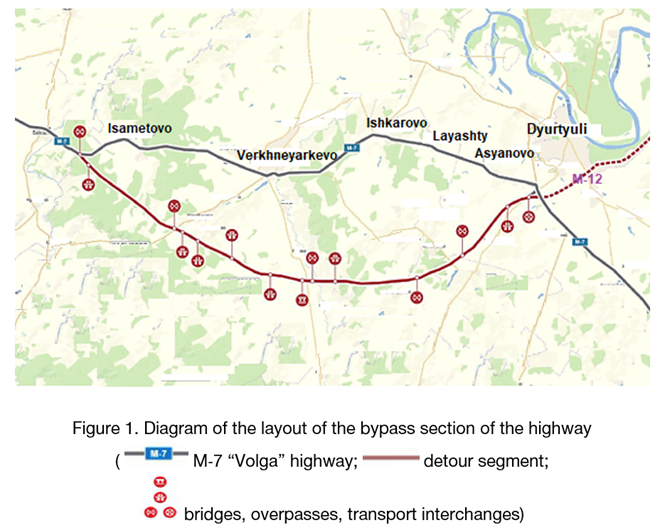
The design engineering of the bypass includes the construction of a four‑lane category IB road with a length of 65 km, six transport interchanges, two bridges, nine bridge‑type overpasses, and 18 tunnel‑type overpasses for the passage of agricultural machinery. Throughout the entire high‑speed section with a permitted speed of 120 km/h, electrical lighting is provided, and traffic flows are separated by a barrier fence [3]. To build multifunctional areas on the detour section, four recreation, roadside service, and parking areas have been constructed in accordance with the requirements of GOST 33062-2014.
The bypass road, as a transport infrastructure facility, is designed for the movement of vehicles and includes land plots within the boundaries of the roadside strip, as well as structural elements and transport structures located on or beneath them, which are part of the technological infrastructure; as well as protective engineering structures, production facilities, and elements of highway infrastructure. The complex of engineering structures of the roadway is divided into the subgrade, asphalt concrete road surfaces, transport buildings, and other structural elements (electric lighting, noise‑reducing screens, etc.).
The relief of the Ilishyevsky district of the Republic of Bashkortostan is a gently undulating plain, which is part of the Pribelskaya Lowland; the landscape is complicated by a network of ravines and gullies. The main principles of geoecological design and construction of highways include: priority of environmental safety for the population; the regulatory requirement for the preventive nature of environmental protection measures; the regional principle and the landscape approach. [4].
To ensure the geoenvironmental and multifaceted safety of the building and operation of the bypass road, the following measures were taken: geodetic surveys were conducted; land allocation was carefully planned, with lands unsuitable for agricultural production being allocated for the construction of the highway; the forest lands were used rationally, which means that trees were felled only when absolutely necessary. To reduce the level of mechanical impact on the agricultural chernozem soils of the Ilishyevsky district, measures are provided in compliance with environmental legislation: storing the removed fertile layer for subsequent reclamation; reinforcing the slopes of the roadbed to protect them from the erosive effects of water and wind by sowing perennial grasses, etc.
The preparatory stage of the bypass road construction includes removing the top soil‑vegetation layer up to 25 cm using a bulldozer, followed by strengthening the soil base with a vibratory roller. During the construction of the earthwork, the following technological sets of work were carried out: detailed layout of road elements and preparation of the base; excavation and construction of embankments; soil compaction; installation of surface drainage (creation of slopes, drains, drainage ditches); final grading and reinforcement of slopes. The building process of the diversion road includes checking compliance with the plan regarding the dimensions and location of the road transport facility, the elevations of the excavation bottom and edges, verifying the elevation of the top point of the embankment taking into account shrinkage, monitoring the surface elevations according to the plan, and checking of the slopes and excavations.
During the construction of the earthwork and the installation of the soil base with a crushed stone and sand mixture for the high‑speed road, heavy-duty dump trucks were used. The effective operation of road construction equipment for soil work: bulldozers, excavators, etc. is closely linked to the geoenvironmental regular transportation of bulk building materials (soil, sand, gravel, crushed stone, asphalt, etc.) by road transport. Various dump trucks were used to transport the diverse materials used in the road construction of the earthwork and soil base for the bypass road. Effective load capacity, unique advantages and adaptability to certain conditions of route length, terrain, and productivity of Russian dump trucks contribute to significant savings in time, diesel fuel, and other resources [5].
Layer‑by‑layer filling of wide embankments less than 5 meters high on high‑speed highways using dump trucks is carried out according to a circular scheme: dump trucks move along the filled layer to the soil unloading point and then return. The rational carrying capacity of dump trucks when transporting soil masses over a distance of up to 3 km is 18-27 tones. Depending on specific tasks and requirements, in addition to standard dump trucks based on the chassis of Russian KAMAZ or Belarusian MAZ vehicles, several types of dump trucks are used in the construction of high‑speed highways: compact mini‑dump trucks; articulated dump trucks; extendable dump trucks, dump truck trains, etc. It is necessary to note the following geoecological characteristic of using vehicles in the process of road construction: the prohibition of maintenance and washing of road vehicles at unequipped sites, etc. [6].
The geoecological features of constructing a bypass road in the winter conditions of Bashkortostan are related to the need to develop frozen soil, clear the snow cover, and other factors. For the building of roads in winter, the regulatory requirements of GOST R 58948-2020 are followed. To reduce costs during winter construction, soil protection against freezing is organized: the soil is plowed to a depth of 30–40 cm, turning the lower layers upward by about 25 cm, and then harrowed. In this case, with mild frosts, the soil practically does not freeze, while with severe frosts, the freezing depth becomes several times smaller [7]. The zoning of the route in winter conditions should take into account geological boundaries that are determined by the natural conditions of the landscape and the requirements for the non‑destructive interaction of the road with the surrounding ecosystem (Figure 2).
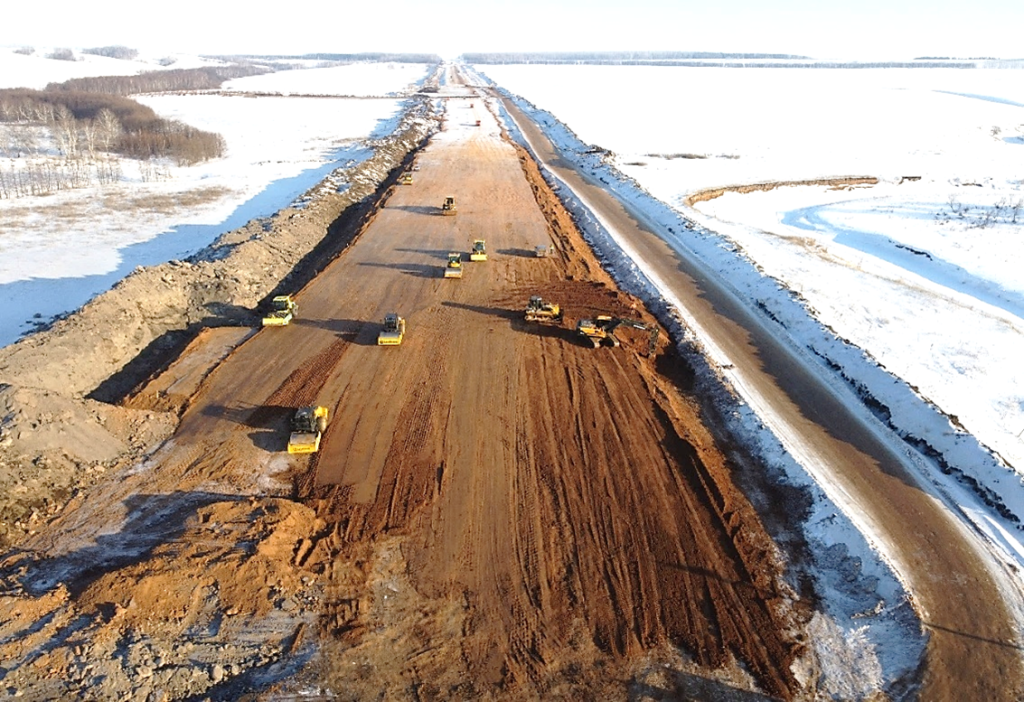
Figure 2. Winter building of the bypass road
In winter, the ground is extracted from prepared dumps; the loosened soil must not contain pieces larger than 20 cm in diameter. When transporting the soil to the site for constructing the embankment of a highway, it is important that it does not have time to refreeze, which is achieved by reducing the loading and unloading time and increasing the speed of the dump trucks. To prevent the soil from freezing to the body of the dump truck during transportation, the bottom is heated by supplying exhaust gases. A drop in temperature, especially below 0°C, leads to a deterioration in the workability of most materials containing binders. In winter conditions, road surfaces should primarily be constructed using discrete materials without the use of binders, as well as prefabricated surfaces and bases made of ready‑made slabs. The lower layers of embankments can be laid in winter using dense clay, while for the upper layers, a drainage sandy soil is used: the favorable compaction factor is 0.95–0.98; if these geotechnical conditions are met, maximum strength is achieved.
To ensure the normative geo‑ecological design of the ground base for the bypass road, the following technological works were carried out in compliance with environmental legislation: additional grading and top‑dressing of the upper layer of the embankment body; a technological break for the self‑compaction of the embankment; construction of temporary access roads, material storage areas, and entry and exit ramps; additional compaction of the soil base, etc. In the low‑lying parts of the landscape in the Ilishyevsky district of Bashkortostan, clay dispersed soils predominate in the bypass section; a negative feature of these soils is the sharp decline in their physico-mechanical characteristics when they become moist, which significantly reduces the possibility of using them in road and transport construction [8]. It should also be noted that there is a particular danger of intense flooding in floodplain areas, where the highway is located on soil bases composed of alluvial deposits (silts, quicksand loams), which belong to weak dispersed soils.
The standard design of a bypass road includes a drainage and leveling layer of quartz base sand, 25-40 cm thick. For main roads, durable crushed stone bases 20-30 cm thick are used; this structure ensures high strength and durability of the roads, which is especially important under heavy loads and temperature fluctuations. The base layers in the road construction have the greatest thickness, which is why they involve a large consumption of construction materials. The use of layers made from reinforced soils with composite binders instead of equivalent bases made from imported stone materials leads to a cost reduction of 20-35%. The use of large‑tonnage industrial waste from Bashkortostan and geopolymer composites [9] based on secondary resources in the building of highways is an energy‑saving solution to the region’s geo‑ecological problems, within the framework of compliance with environmental legislation.
One of the trends in the design and building of regional roads, taking into account the multifaceted geo‑ecological factors of Bashkortostan, is the optimized selection of stabilization strengthening technologies for dispersed weak soils of the bases, based on data from mineralogical, physico-mechanical, and X‑ray phase analyses of the component composition of soils and composite binders based on lime‑containing waste [10-12]. This resource‑saving approach makes it possible to create durable geopolymer materials produced using available local secondary resources and to substantiate the environmental ecosystem assessment of recultivated landscapes.
On the bypass highway, the road surface structures include asphalt concrete layers designed using the volume‑functional design methodology, laid using the “Superpave” technology. Article [13] analyzes the undeniable advantages (resistance to rutting and fatigue damage) and disadvantages (expensive super‑absorbent polymers and layers that are complex in terms of design technology) of the “Superpave” asphalt concrete technology. The upper layer of the asphalt concrete pavement along the entire length of the bypass highway is laid with a crushed stone-mastic asphalt concrete mixture (SMA‑16) using cube‑shaped fractionated crushed stones; the lower layer of the pavement is 9 cm of SP‑22E asphalt concrete; the upper layer of the base is 12 cm of SP32E, with a total thickness of 25 cm.
The most promising method for ensuring high wear‑resistant performance indicators of the transport and operational condition of a bypass section of a highway (the strength of asphalt concrete, smoothness, roughness, and the grip properties of the top layer of the coating) is surface synergistic treatment [14]. The use of bitumen binder improved with structuring additives of functional copolymers increases the durability of asphalt concrete pavements by 1.5 times [15]. The optimized layers of the roadbed of the bypass segment of the M‑7 highway include natural underlying soils, reinforced soil bases, a crushed stone layer and an asphalt concrete pavement. Complementary reinforcement enhances the physical and mechanical properties of the ground, increases the modulus of elasticity, and improves the technical and operational characteristics of the asphalt concrete pavement (Figure 3).
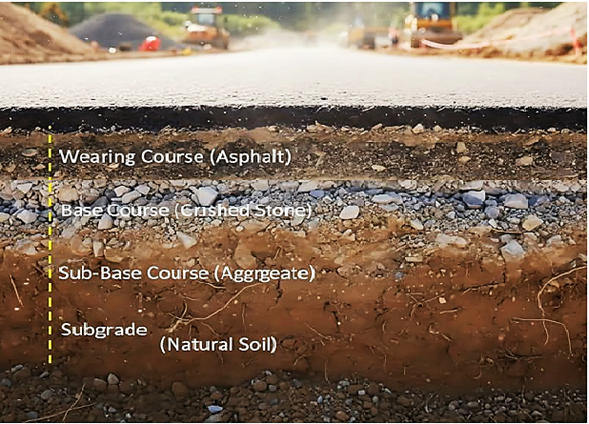
Figure 3. Optimized layers of a roadway detour segment
The negative impact of highways on the surrounding ecosystem of the bypass section is manifested in the emission of toxic exhaust gases from vehicles into the atmosphere, the pollution of surface water bodies and soils, and the creation of elevated noise levels. In the context of the geo‑ecological potential for the sustainable development of humanity [16], highways should be considered not only as existing objects within the framework of environmental legislation, but also taking into account their life cycle. Often, the building and operation of roads lead to the intensification of adverse natural processes – erosion, landslides, waterlogging.
Taking into account the specified circumstances, the list of adverse geoecological impacts of the intensive use of highways is supplemented by the following:
− emissions resulting from the reorientation of traffic flows onto natural‑anthropogenic geosystems;
− negative effects generated by road infrastructure and service facilities;
− changes in the hydrographic conditions of the construction area due to the emergence of significant static or dynamic loads;
− the occurrence of wind or water erosion due to the locally increased concentration of motor vehicle traffic [17].
To normatively reduce the impact of liquid‑phase pollutants from highways with an allowed vehicle speed of 120 km/h on natural geo‑ecosystems, water treatment facilities are designed. Rainwater runoff treatment modules are intended for the purification of surface and meltwater that flows from asphalt concrete road surfaces. The simplest local surface water treatment facilities (Figure 4) include a tray and a filtration chamber, where dirty sand and petroleum products are separated.
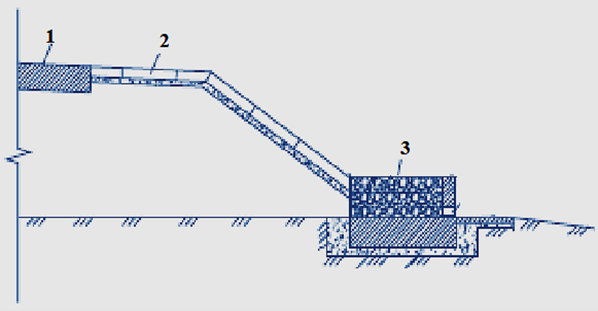
Figure 4. Diagram of a local water treatment facility on a highway
(1 – asphalt concrete road surface; 2 – drainage channel;
3 – filtration chamber)
In recent decades, the problem of environmental pollution by technogenic waste generated during the operation of vehicles in road construction has been exacerbated: worn‑out tires, spent oils, batteries, etc. The rapid growth in the number of trucks and passenger cars in Russia, along with the lagging development of mitigating factors in the geo‑ecological components of the transport infrastructure, a high share of vehicles with a long service life and low environmental performance, and an underdeveloped system of intelligent traffic flow management on highways have led to a sharp increase in the aforementioned negative factors [18]. Each state of the objects and components of a natural‑anthropogenic geosystem, including urbanized ones, is determined by its entire genesis, the multitude of complementary relationships, as well as by natural, anthropogenic, and technogenic factors that influence the state of the ecosystem.
To minimize emissions of pollutants during the building and operation of highways on natural and anthropogenic geoecosystems in compliance with environmental legislation (state standards and requirements for sustainable development in accordance with GOST R 70049-2022), it is necessary:
- updating of the fleet of road construction equipment, switching to gas-engine fuel; regular technical inspection;
- monitoring of exhaust gases of vehicles.
To ensure geo‑ecological safety and preserve the water protection zone of rivers along the bypass highway, it is recommended to:
♦ carry out fueling, washing, and repair of road vehicles only at specially equipped sites during construction;
♦ equip the construction sites along the highway with mobile containers for household and industrial waste;
♦ in the event of accidental leaks of petroleum products, the contaminated area must be covered with quartz sand, and the contaminated sand must be collected in a special container and disposed of.
During the building and operation of a bypass highway, industrial geoecological control (monitoring) over the nature of changes in environmental components is important: regulatory management of the removed layer of fertile soil; control over the environmental friendliness of materials used for filling the paving; monitoring the development of linear and planar soil erosion; monitoring the timely fixing of slopes on completed embankment sections; monitoring of building and household waste management; monitoring of remediation of construction sites, as well as organization of interaction with supervisory authorities [19]. The current trends in the geo‑ecological features of road and transport building of highways include the design and placement of automatic air monitoring points as elements of intelligent transport infrastructure, local water treatment facilities, noise‑reducing screens [20, 21]. It should also be noted that, in compliance with environmental legislation, it is mandatory to create bi‑crossings on highways along the migration routes of large animals, to implement special measures to protect fish‑protection zones, and to carry out compensatory planting of green spaces to enhance the region’s tourist attractiveness.
In conclusion, summing up the results, that the tasks of ensuring the geo‑ecological minimization of the impact of highways on natural ecosystems are multifaceted. Strict adherence to environmental protection requirements in the building of bypass sections and the operation of speed highways makes it possible to reduce the anthropogenic load on the ecosystems of the northwestern regions of Bashkortostan.
References
1. Litvinova Yu.O., Ponomarev Yu.Yu. Strategy for the development of the high‑speed road network in Russia until 2030 // Transport of the Russian Federation. Journal on science, practice, economics. 2016. No.4(65). P.18–21. EDN WMAHWB.
2. Pugachev I.N., Kazarbin A.V. Improving the country’s transport system and its regions through the digital transformation of Russia’s transport sector // Vestnik SibADI. 2023. V.20, No.6(94). P.762-772. EDN KPMQMV.
3. Ivanova O.V., Glazachev A.O., Khalikov R.M. et al. Efficient operation of road transport during the construction of a four‑lane section of a speed highway // Modern development of technologies: Collection of the 3rd Internat. Conf. Voronezh: Publ. “Universit. book”, 2025. P.164–167. EDN BRKUBU.
4. Shestakov N.I., Chertes K.L. Parameters for assessing the impact of road construction facilities on the environment // Chemistry. Ecology. Urbanistics. 2024. V.3. P.251-255. EDN KKCQPE.
5. Khalikov R.M., Ivanova O.V., Pavlov S.Yu. et al. Innovative technologies in the construction of section of the federal highway M-12 // Trends in the development of science and education. 2024. No.108-13. P.62-65. EDN SKRIKH.
6. Tarasova O.Yu., Moskaleva S.A., Larina A.V. Geoecological aspects of road design // Modern problems of territorial development. 2018. No.2. P.10. EDN XRHYHZ.
7. Dubenkov A.A. Comprehensive assessment of engineering‑geological and permafrost conditions in the zoning of a road route // Vestnik SibADI. 2013. No.4(32). P.46–52. EDN QZGGAL.
8. Glazachev A.O., Pavlov S.Yu., Shaikhullin I.R. et al. Resource-saving ways to strengthen soils of foundations of the roadway // Trends in the science and education. 2024. No.105-13. P.10-13. EDN NZOMXA.
9. Khalikov R.M., Ivanova O.V., Latypova Z.B. et al. Resource-saving production of geopolymer composites based on multi-tonnage industrial waste for use in road construction // International Journal of Professional Science. 2026. No.6-2. P.142-152. EDN PAECTL.
10. Latypova Z.B., Khalikov R.M., Glazachev A.O. et al. Geoecological aspects of the use of tonnage soda production waste in Bashkortostan // Problems of regional ecology. 2023. No.4. P.68-72. EDN ZFOTOL.
11. Khalikov R.M., Ivanova O.V., Pavlov S.Yu. et al. Effective reinforcement of the foundations of the roadway with lime-slag binders based on tonnage waste // Trends in the development of science and education. 2023. No.103-7. P.116-119. EDN WSOPAU.
12. Glazachev A.O., Sinitsin D.A., Nedoseko I.V. et al. Composite materials based on soils reinforced with chemical waste for transportation construction // AIP Conf. Proc. 2026. No.3409(1): 020001.
13. Privezentseva S.V., Ivanov A.F. Analysis of the use of new technologies and materials on the M‑12 speed highway // Vestnik MGSU. 2023. V.18, No.8. P.1179–1185. EDN CZFWAX.
14. Glazachev A.O., Pavlov S.Yu., Ivanova O.V. et al. Synergetic technologies for designing wear‑resistant layers of asphalt concrete road surfaces // Trends in the development of science and education. 2024. No.106‑9. P.22–25. EDN XFHWBO.
15. Nedoseko A.I., Khalikov R.M., Pavlov S.Yu. et al. Supramolecular improvement of the performance characteristics of asphalt concrete road pavements using structuring additives of functional polymers // Smart composites in building. 2025. V.6, No.4. P.43-54. EDN BGNCBM.
16. Zaburaeva Kh.Sh. Geoecological potential of sustainable development // Bulletin of the Immanuel Kant Baltic Federal University. 2014. No.1. P.175-181. EDN RVLNOD.
17. Samysheva I.M., Pavlova L.V. Environmental aspect of the operation, construction, and reconstruction of highways, bridges, and tunnels // Ecology and scientific and technological progress. Urban studies. 2015. V.1. P.498-503. EDN VUZAWB.
18. Khalikov R.M., Ivanova O.V., Latypova Z.B. et al. Optimized functioning of the intelligent transport infrastructure of speed highways // International Journal of Professional Science. 2026. No.3-2. P.230-239. EDN JAMOGG.
19. Sobyanina E.A., Yakovleva E.A. Environmental aspects of road construction and operation // Modern technologies in building. Theory and practice. 2021. V.2. P.333-339. EDN UPKVUR.
20. Ivanova O.V., Glazachev A.O., Pavlov S.Yu. et al. The demanded application of artificial intelligence in managing traffic on highways // Perspectives of Technology Development: Collection of the 3rd All‑Russian Conf. Voronezh: Publ. “Universit. book”, 2025. P.167–170. EDN FXSQLT.
21. Buzyakova I.V. Geoecological assessment of anthropogenic load on urban soils // The Eurasian Scientific Journal. 2024. V.16. No.2. EDN AXIHBN.