
Targeted increase in the impact resistance of concrete in the construction of culvert transport structures
The successful implementation of the national project “Infrastructure for Life” in Russia provides for a significant acceleration of the construction of highways and road transport facilities. Therefore, the innovative search for a directional increase in the impact resistance of concrete for transport purposes remains relevant. This article is aimed at considering technological approaches to increase the operational durability of concrete culvert transport structures. The functional purpose of culverts is the optimal passage of small watercourses that occur during heavy rains and intense snowmelt. Culverts for road transport purposes must meet the operational requirements of strength, reliability of water flow passage, resistance to damage and durability. One of the effective ways to increase the impact resistance of hydraulic engineering concrete transport composites is the modification of various types of dispersed reinforcement: basalt, polymer, steel fibers. The targeted introduction of steel fiber into the concrete composition (with a diameter of 0.3 to 1.0 mm) with an optimal percentage of volumetric reinforcement of 1.5% after hardening of the fiber concrete increases the tensile strength by 120-150%. Calculations of culverts of transport infrastructure using a directional increase in the impact resistance of steel fiber reinforced concrete were performed for two load variants (symmetrical temporary load application and asymmetric) and for two embankment heights above the structure (1 and 4 meters). Culverts of highways using steel-fiber reinforced concrete have increased crack resistance, water resistance, impact resistance, and tensile strength up to 30 MPa.
transport infrastructure, culvert, fibro concrete.
Currently, the implementation of the national project «Infrastructure for Life» of the Russian Federation provides for a significant increase in the volume of construction of highways and road transport facilities. One of the most massive engineering structures of the transport infrastructure are culverts [1] of various designs (metal, reinforced concrete pipes of round or rectangular cross-sections, small arched filling bridges, etc.), which are designed for continuous or short-term passage of water masses. Under intense dynamic influences (pulse loads, etc.), areas of intense tensile stresses begin to form in reinforced concrete culverts, which can lead to the destruction of transport structures. Therefore, an alternative search for a targeted increase in the impact resistance of concrete for road transport purposes remains relevant.
The purpose of this article is to consider rational approaches to increase the operational durability of concrete transport culverts.
The transport infrastructure of the highway includes not only a structural roadway, but also a complex of engineering structures, elements of arrangement and roadside service [2, 3]. Hydraulic engineering structures on highways are most often culverts (Figure 1) in single or multi-row design, as well as filling arched bridge structures in reinforced concrete or steel execution.
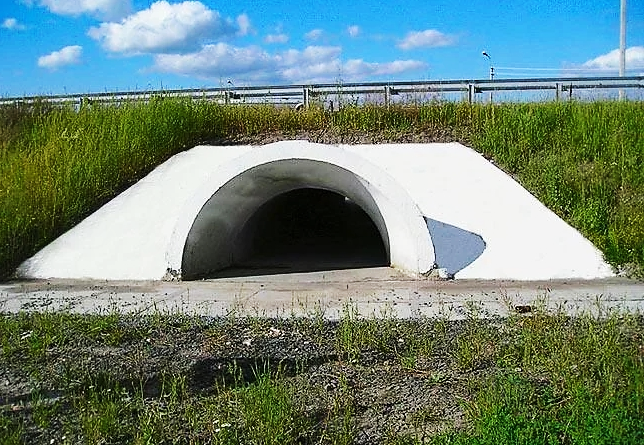
Figure 1. Culvert structure of the highway
According to GOST 32871-2014 «Public roads. Culvert road pipes. Technical requirements» a culvert is an artificial structure designed to allow small permanent or intermittent watercourses to pass under road embankments. To eliminate the accumulation of water near the embankment of the highway and its erosion, pressure-free culverts with a diameter of up to 2 meters are mainly designed and created. The functional purpose of culverts in Russia is the timely passage of small watercourses that occur periodically (during heavy rains, heavy snowmelt, etc.).
Hundreds of thousands of culverts are currently used on the highways of the Russian Federation and Bashkortostan, which vary in construction materials, hole size and cross-section shape, type of heads, slope and other design features. Culverts under embankments on highways account for about half of all artificial structures. Hydraulic engineering culverts [4] of the transport infrastructure are operated under conditions of alternating drying, cyclic freezing and thawing, and the abrasive effect of water flow. Therefore, culverts must functionally meet the operational requirements of strength; reliability and safety of water flow passage; resistance to damage; fire resistance; cost-effectiveness; environmental friendliness and durability.
Hydraulic culverts of highways consist of pipe links and heads. The pipe links can be circular or rectangular in cross-section, supported on reinforced concrete slabs or shaped blocks for round pipes. At the entrance and exit from the pipe, the heads are arranged, which smoothly introduce the flow of water into the pipe and output, as well as reduce the risk of erosion of the embankment and riverbed. The design of the heads consists of a portal wall and two sloping wings, sunk into the ground and mounted on a 10 cm thick crushed stone base. The type of foundation is selected during the design process depending on the local engineering and geological conditions, the groundwater level, the hydrological mode of operation of the culvert, and the availability of building materials.
It should be noted that in order to avoid dangerous filtration, liquefaction and removal of soil from the embankment of the highway, water should not be allowed to seep out of the culvert. One of the most effective ways to increase the impact resistance and durability of hydraulic concrete composites for road transport purposes is the modification of various types of dispersed reinforcement: basalt, polymer, steel fibers [5, 6]. Fiber components interact with a three-dimensional network of calcium-silicate-hydrate binder Portland cement, contribute to reducing porosity and compaction of the cement stone structure, and increase shear stresses of the adhesive bond of the matrix. The targeted introduction of the appropriate complementary fiber into the structure of hydraulic engineering concretes makes it possible to significantly reduce shrinkage cracking and increase bending strength.
Also be noted that the combination of fiber reinforcement with hydrophobization of high-strength concrete is of particular importance for hydraulic culverts. Hydrophobic additives can reduce water absorption, capillary suction and permeability of concrete composites for road transport purposes. Rectangular culverts, due to their large capacity of water volumes, are used under embankments up to 20 m high on both intermittent and small permanent watercourses. If necessary, rectangular culverts functionally serve for convenient bio-crossings of domestic or wild animals on their natural migration routes [7, 8].
In the practice of road transport construction, rectangular pipes consisting of blocks are used to increase the impact resistance of fiber-reinforced concrete along with solid block sections with holes of 2.0 m; 2.5 m; 3.0 m; 4.0 m, consisting of two wall blocks, a tray block and a floor block, as well as pipes made of slab elements. The main elements of culverts are their body, foundation, inlet and outlet heads (Figure 2).
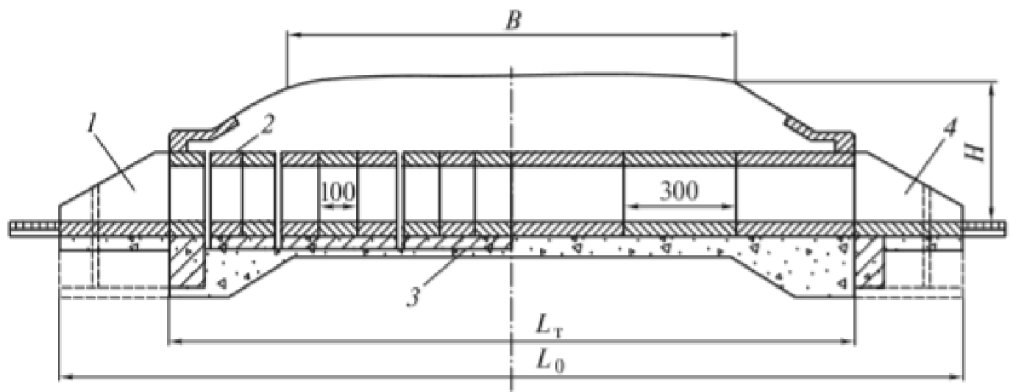
Figure 2. Elements of a culvert on a highway: 1 – inlet head;
2 – pipe body (links); 3 – foundation; 4 – exit head;
(B – width of the embankment of the roadbed;
H – height of the ground floor, LT – length of the pipe,
L0 –total length of the culvert)
To regulate the water flow, ensure smoothness of its flow and prevent longitudinal displacements of elements during embankment landslides, the inlet and outlet sections of culverts are equipped with heads: portal, bell-shaped, etc. Quite promising structural materials for the construction of innovative culvert infrastructure are disperse-reinforced composite fiber-reinforced concrete. To increase the strength characteristics of concrete for road transport purposes, metal, basalt, glass and carbon fiber fibers are added to the composition [9].
Composite fiber concrete is also more resistant to impacts due to its strength and plasticity, which is undoubtedly necessary when operating bridge structures that experience heavy loads and dynamic impacts on a daily basis. The expansion of the use of arched low-span filling bridges made of steel-fiber concrete elements is an innovative direction for improving the quality of functioning of culverts [10, 11].
Careful research has revealed that the most important physical and mechanical characteristics of fibrocrete are strength, toughness, and the work required to fracture under axial tension and bending. The directional introduction of steel fiber into the concrete mix (with a diameter df from 0.3 to 1.0 mm) with an optimal percentage of volumetric reinforcement of 1.5% after hardening of composite fiber concrete is reliably connected to it due to adhesion forces, keyway engagement on the surface or anchors at the ends of the fibers. A comparative analysis of some of the basic physical and mechanical characteristics of traditional concrete and hydraulic fiber-reinforced concrete is given in Table 1.
Table 1
Technological parameters of ordinary concrete and fibro concrete
| Values of characteristics | Ordinary concrete | Fibre concrete |
| Axial tensile strength, MPa | 1,5-4,0 | 9,0-30,0 |
| Compressive strength, MPa | 21,0-35,0 | 35,0-80,0 |
| Shear strength, 10-5 MPa | 2,0-4,5 | 4,7-8,5 |
| Coefficient of thermal expansion, 10-6 cm/ оС | 9,9-10,8 | 8,4-11,0 |
| Impact strength, kg/m | 4,8 | 15,8 |
| Cracking resistance index (according to heat resistance tests) | 1 | 7 |
| Fracture toughness index | 1 | 12-17 |
The impact resistance in fiber-reinforced concrete of road transport structures is assumed by steel fiber fibers instead of rod reinforcement, which increase its tensile strength by 120-150%. Later, during operation, when exposed to tensile or compressive stresses, fiber and concrete work together, resisting deformations much better than unreinforced concrete. In addition, the targeted use of dispersed reinforcement makes it possible to partially or completely eliminate prestressing and reinforcement work in road construction. Disperse-reinforced road bridge structures using fibre concrete have increased crack resistance, water resistance, impact resistance, and wear resistance, which leads to a significant increase in their durability and operational reliability [12-14].
In the Republic of Bashkortostan, with a large number of small rivers and streams, the need for culverts during the construction and operation of highways is very high. The wider construction and operation of arched fill culverts is effective for the following reasons:
– operating costs are significantly reduced, since arched filling bridges do not have expansion joints or supporting parts;
– due to the relatively small mass of the elements of the culvert bridge, there is no need to use high-capacity cranes;
– the use of arched bridges can significantly reduce the cost of construction and installation work compared to the use of classical girder systems of bridge transport structures. Since hydraulic structures are built in floodplain areas with weak soil foundations, there is a need to build a pile foundation, not only with vertical, but also with an inclined arrangement of piles, which is difficult for road construction; technological problems also arise with concreting monolithic grillwork.
The culvert structure of the filling arch bridge has a span of 4 m or 5.7 m and consists of two semi-arches that rest on a slab-type foundation block and form a static scheme in the form of a two- or three-hinged arch. This scheme makes the structure immune to possible displacements and subsidence of the supports: the results obtained by calculation make it possible to apply these structures taking into account the temporary load of НК-100 in embankments with a total height of 3.5 to 7 m. The developed cross-section makes it possible to place such bridges on watercourses with a maximum water flow of up to 27 m3/s (with a channel slope of 0.008), as well as to use them as an alternative to girder bridges with a span of 12-15 m.
The optimized use of arched culvert filling bridges using a directional increase in the impact resistance of fiber–reinforced concrete has a number of significant advantages:
○ being located in the embankment of the highway, the arch bridge does not disrupt the continuity of the roadbed, does not change traffic conditions, does not require changing the type of roadway, provides an ideal interface of the bridge with the embankments of approaches;
○ the operating costs are low compared to girder bridges, there are no expansion joints, transition plates and supporting parts, which significantly affect the comfort of movement and durability of the culvert.;
○ the structural elements of the arch bridge have a small mass, so no high-capacity cranes are required for installation.;
○ arched culvert bridges of highways are beneficial from the point of view of economic efficiency, as they allow to reduce the cost of construction by almost half.;
○ arched bridges fit into the natural landscape, which is also a sought-after trend in innovative construction technologies.
Calculations of culverts of the highway infrastructure using a directional increase in the impact resistance of steel fiber reinforced concrete were performed for two load variants (symmetrical temporary load application and asymmetrical) and for two embankment heights above the structure (1 and 4 meters). The necessary calculations were performed using the software package “PLAXIS” finite element software package, which implements the joint operation of bridge structural elements with the soils of the base and embankment of highways.
To study the stress-strain state of the arch links of fill bridges of culverts of road infrastructure operating as part of a structure under conditions of flat deformation, the “PLAXIS 8.2” software package was used, which makes it possible to simulate the physico-mechanical characteristics of the soils of the base and embankment of arches and to implement the joint operation of reinforced concrete structures under the influence of loads from vehicles and the ground’s own weight. In the design calculations of the culvert of the highway, the most unfavorable asymmetric position of the load relative to the span was considered when the load moves within the span of the structure.
The standard running load, reduced to one meter in the width of the bridge from the impact of the НК-100 wheel load:
at a filling height of 1 to 1.9 m
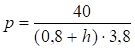
(1)
when the filling height exceeds 1.9 m
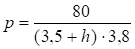
(2)
where p – linear load;
h – height of the filling above the arch.
Figure 3 shows the design of the culvert of the highway transport infrastructure – an arched fill bridge, which is a single-span arch with a span of 4.0 m circular shape, made in a double-hinged version. The lifting boom is 2.0 m; the cross-sectional height is assumed to be 250 mm. The calculation of the double-hinged arch with an estimated span of 4 m of the highway culvert was carried out for constant loads of its own weight and embankment H = 3-7 m, taking into account the temporary load of НK-100.
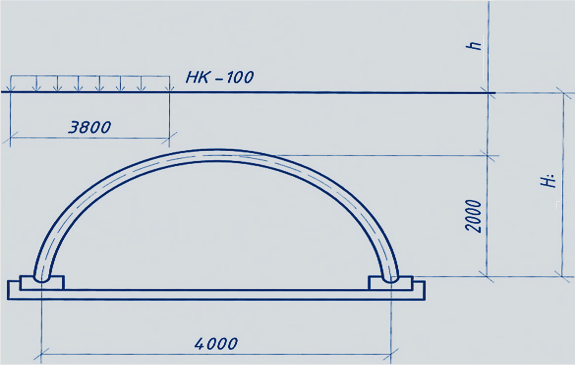
Figure 3. Diagram of the arch of the culvert of the filling bridge of the highway with a span of 4 m
Calculations of the bearing capacity of the foundations of a backfill arch bridge (with a nominal span of 4 m), made for two types of soil conditions (with a sufficiently large depth of fluidplastic clays) have shown that, compared with a standard strip foundation made of precast reinforced concrete slabs, the use of a foundation tightening plate makes it possible to reduce the total draft of the foundation by more than two times, to bring the value closer to the normative indicators. The targeted increase in the impact resistance of steel fiber concrete makes it possible in most cases to abandon the expensive pile foundation with a monolithic grillwork.
The highway’s transport infrastructure is not just an asphalt–concrete roadway, but an integrated engineering complex, where each element plays its own irreplaceable role. It should be noted that the technological part of the highway includes: structural elements (roadbed, asphalt pavement, roadsides); road transport structures (bridges, overpasses, overpasses, culverts under the embankment, noise barriers, etc.). All this must be taken into account especially during the construction of high-speed highways, such as the M-12, in order to effectively use the capabilities of intelligent transport infrastructure and unmanned vehicles [15-17].
Therefore, a modern highway should be considered as a complementary complex of engineering structures designed to ensure round-the-clock, off-season, safe and convenient movement. The design and complexity of transport facilities depends on the intensity of traffic, as well as on natural factors (climate, vegetation, hydrogeological conditions, soil and geological structure and terrain). The geometric increase in vehicle traffic without adequate infrastructure support generates a number of serious problems related to environmental degradation and deaths caused by road accidents.
As elements of road transport structures, drainage structures are arranged at the intersection of a highway with streams, ravines, etc., through which water flows from rains or snowmelt. Road transport construction requires a large number of prefabricated reinforced concrete products and structures manufactured at the factory; these include road curbs, spillway trays, culverts. Drainage trays are made of concrete of compressive strength class B20-B25, used for installation in traffic areas and pedestrian areas to collect and drain water from the surface of highways and sidewalks. Concrete drainage trays are operated in harsh conditions and must have high water resistance, frost resistance, abrasion resistance, resistance to the aggressive action of the aquatic environment and deicing saline solutions. One of the ways to improve the characteristics of steel-fiber-reinforced concrete road transport products is the treatment with various hydrophobic compounds [18].
Many domestic enterprises for the production of reinforced concrete products have mastered the bench technology of non-formwork molding, when it is possible to produce the vast majority of products and structures for road transport purposes. All products produced on long non-formwork molding stands are prestressed, which significantly increases their bearing capacity and crack resistance. It should be noted that concrete in road transport structures that are susceptible to outdoor operation must have very high frost resistance and water resistance (W10 and more), and for road slabs it also has high operational wear resistance of the front layer [19].
The technological principles and methods of dispersed reinforcement in the process of targeted increase in the impact resistance of fiber-reinforced concrete structures of culverts largely depend on the type of matrices. For the manufacture of dispersed reinforced fiber-reinforced concrete, concretes with a certain aggregate granulometry are used, with unique characteristics of spatial ordering of nanostructures during the structuring of binders [20]. Sometimes it is advisable to use light concrete technologically; the type of fiber-reinforced concrete determines the nature of the rational direction of dispersed reinforcement and the geometric parameters of the dispersed reinforcement of the optimal compositions of the «concrete–fiber» composition.
Steel fiber concrete with a low percentage of reinforcement (not exceeding 1.0–1.5%) has the ability to perceive tensile stresses even after cracking: the introduced fiber reduces brittleness to some extent and provides the possibility of small deformations without destroying culverts. Impact-resistant fiber-reinforced concrete is indispensable in the construction of hydraulic structures, where the bending strength of the concrete composite plays an important role. Promising technologies are those that are suitable for the manufacture of structural elements from complex fiber-reinforced concrete in shock-resistant structures for transport purposes [21].
In conclusion, summarizing the results, it can be said that the structures of culverts for highways using steel fiber reinforced concrete have increased crack resistance, water resistance, impact resistance, tensile strength up to 30 MPa, which leads to a significant increase in their durability and operational reliability. The construction of culverts made of steel-fiber-reinforced concrete arches with a foundation slab has a multifunctional purpose and has prospects for use in a variety of ground conditions.
References
1. Vysotsky L.I., Izyumov Yu.A., Vysotsky I.S. Elements of drainage on highways. Saint Petersburg: Lan Publ., 2015. 192 p. EDN TXPJPD.
2. Solodkiy A.I., Gorev A.E., Bondareva E.D. Transport infrastructure. Moscow: Yurayt Publ. House, 2019. 290 p. EDN UUGXSV.
3. Zakolyukina E.S. Features of the functioning of transport infrastructure in the economy of the region // Creative economy. 2025. V.19, No.2. P.239-258. EDN JZODCH.
4. Tkachev A.A., Anokhin A.M., Belov V.A. et al. Water support and culvert hydraulic structures. Novocherkassk: Publ. "Lik", 2024. 250 p. EDN IXXKIU.
5. Nedoseko A.I., Khalikov R.M., Pavlov S.Yu. et al. Supramolecular improvement of the performance characteristics of asphalt-concrete road coverings by structuring additives of functional polymers // Smart composites in construction. 2025. V.6, No.4. Р.43-54. EDN BGNCBM.
6. Leonovich S.N., Sadovskaya E.A. Strength indicators of fiber reinforced concrete with carbon nanomaterials // Science and Technique. 2024. V.23, No.3. P.219-224. EDN YKQKPX.
7. Bogushevich S.A., Samuilov V.M., Nevolin D.G. et al. High-speed highway M-12 Moscow – Tyumen: prospects and stages of construction // Innovative transport. 2022. No.1(43). Р.3-7. EDN CQPVXF.
8. Khalikov R.M., Ivanova O.V., Pavlov S.Yu. et al. Innovative technologies in the construction of the Dyurtyuli-Achit section of the M-12 federal highway // Trends in the development of science and education. 2024. No.108-13. Р.62-65. EDN SKRIKH.
9. Chernilnik A.A., Smachny V.Yu., Yelshaeva D.M. et al. The influence of the type of fiber fibers used on the strength and deformability of dispersed reinforced lightweight concretes // Bulletin of BSTU n.a V.G. Shukhov. 2022. No.2. Р.20-29. EDN DFYXQD.
10. Babkov V.V., Nedoseko I.V., Distanov R.Sh. et al. Steel fiber reinforced concrete in the manufacture of road products and structures // Building materials. 2010. No.10. Р.40-45. EDN NBIIAT.
11. Khalikov R.M., Vildanova V.F. Macromolecular protective anticorrosion coating of steel pipelines // Actual problems of engineering: Materials of the Intern. conf. Ufa: BashSU, 2020. P.193-198. EDN BVOTYB.
12. Levkovich T.I., Mevlidinov Z.A., Fedin N.A. The use of fiber-reinforced concrete mixtures in the construction of foundations and road coverings // Transport structures. 2019. V.6, No.3. P.1. EDN ONXMTO.
13. Bondarev B.A., Sturova V.A., Liventseva A.A. The use of fiber-reinforced concrete in transport structures // Safety of the Russian construction fund: Materials of the International conf. Kursk: Publ. "Universit. the Book", 2023. Р.243-247. EDN UHSTWB.
14. Sinitsin D.A., Khalikov R.M., Bulatov B.G. et al. Technological approaches to directed structure formation of construction nanocomposites with increased corrosion resistance // Nanotechnologies in Construction. 2019. V.11, No.2. Р.153-164. EDN YEORWM.
15. Lipatov M.S., Maksimov Ya.V. Application of new technologies on the example of unmanned vehicles using artificial intelligence // International Journal of Professional Science. 2024. No.3-2. P.6-12. EDN WXBFLT.
16. Ivanova O.V., Pavlov S.Yu., Glazachev A.O. et al. Innovative unmanned vehicle operation technologies in high-speed federal highways // Modern innovations in engineering and technology: Collection of the Internat. conf. Kursk: Publ. "Universit. book", 2025. Р.139-142. EDN XOADRL.
17. Khalikov R.M., Ivanova O.V., Pavlov S.Yu. et al. Intelligent transport infrastructure on the Dyurtyuli–Achit section of the M-12 federal expressway // Actual problems of science and education: Collection XLVIII Internat. conf. Moscow: Publ. "Academic Environment", 2026. Р.41-50. EDN IBLPDM.
18. Ivanova O.V., Khalikov R.M., Salov A.S. et al. Technological equipment management for 3D additive printing of building nanocomposites // Nanotechnologies in Construction. 2021. V.13, No.2. Р.117–123. EDN PDLKKY.
19. Kinyagulova L.F., Khafizov A.A., Nedoseko A.I. et al. Improving the durability and operational reliability of concrete in road transport products and structures // Silicate engineering and technology. 2026. V.33, No.3. Р.242-251. EDN CJCDWH.
20. Ivanova O.V., Glazachev A.O., Pavlov S.Y. et al. The in-demand application of artificial intelligence in traffic management of the M-12 motorway // Prospects for the development of technologies: Collection of the 3rd All-Russian conf. Voronezh: Publ. "Univer. book", 2025. Р.167-170. EDN FXSQLT.
21. Morgun V.N., Bogatina A.Yu., Revyakin A.A. et al. Prospects for the use of complex reinforced concrete in building structures of transport infrastructure facilities // Transport of the Urals. 2021. No.2(69). Р.63-67. EDN ZTBBCW.