A study on determining gender equality in industrial areas (In case of “Erdenet Factory” SOE)
Gender equality has become an important strategic factor in the internal organization of organizations, human resource management, and productivity. In Mongolia, the World Bank’s “Mongolia Gender Assessment” study in 2024 highlighted the gender gap, policy implementation, and monitoring weaknesses. UN Women’s “Gender Snapshot 2025” report showed that the global gender gap is slowly closing, and warned of the need for policy reforms and support mechanisms. Erdenet Plant is a strategically important facility in Mongolia, with over 7,000 employees and a male-dominated structure, which poses challenges in implementing gender policies. Although the Gender Equality Law and the Sustainable Development Goals are the basis for policies to support women’s leadership, women’s participation in decision-making is insufficient in an industry-dominated organization.
The purpose of this study is to determine the level of gender equality policy and implementation at “Erdenet Plant” SOE, and to assess the current state of employee attitudes, perceptions, and participation. The study combined qualitative and quantitative methods and collected data from 300 employees using questionnaires, interviews and observations. The results show that the average participation of female employees in management is 19%, while gender gaps are observed in workload, pay gap and career advancement opportunities. The study concluded that top management support, cultural change and the effectiveness of training programs are important in implementing organizational policies. However, increased support from management and the introduction of gender-sensitive training and programs have had a positive impact. Although female employees make up 32% of the total workforce, they represent 1% of decision-making levels.
Gender Policy, Gender Equality, Women's Leadership, Organizational Culture, Policy Implementation
INTRODUCTION
Gender equality refers to the condition in which women and men enjoy equal rights, responsibilities, and opportunities in social, economic, and labor relations. At the level of industrial workplaces, gender equality is not only a matter of human rights but also a critical factor influencing organizational productivity, sustainable development, occupational safety, and innovative capacity.
Scholars such as Acker (1990) and Connell (2006) conceptualize organizations as “gendered structures,” arguing that divisions of labor, managerial hierarchies, wage systems, and allocation of hazardous tasks are often shaped by gender norms and stereotypes. Industrial sectors such as mining, manufacturing, construction, and energy have traditionally been perceived as “male-dominated,” which has contributed to persistent gender inequalities within these workplaces.
The significance of gender equality in industrial settings can be explained through several key dimensions. First, human resource efficiency is enhanced when gender equality is ensured. Gender-inclusive workplaces are better positioned to attract, retain, and effectively utilize a diverse and skilled workforce. Second, occupational safety and health (OSH) outcomes improve when gender perspectives are integrated into workplace policies. According to studies by the International Labour Organization (ILO, 2018), enterprises that implement gender-sensitive OSH policies tend to experience lower rates of occupational accidents and injuries. Third, organizational culture and leadership benefit from gender equality. Inclusive and participatory management practices foster transparency, accountability, and higher levels of job satisfaction among employees.
Gender inequality in industrial workplaces manifests in several interrelated forms, including:
- Gender-based occupational segregation, where physically demanding or high-risk jobs are predominantly assigned to men, while women are concentrated in auxiliary or service roles;
- Underrepresentation of women in leadership positions, particularly at middle and senior management levels;
- Gender pay gaps, even in positions of equal value and responsibility;
- Inadequate working conditions, such as the lack of gender-appropriate personal protective equipment, sanitation facilities, and flexible working arrangements;
- Sexual harassment and discrimination, often embedded in informal workplace cultures and power relations.
In recent years (arXiv, 2024; MDPI, 2025), research has examined the impact of technological automation, the digital economy, and artificial intelligence on gender gaps. These studies suggest that as digital skills increase, the labor participation and wage gap between women can be reduced. Implementing gender-sensitive digital transformation in mining organizations is one strategy to increase women’s participation.
Therefore, gender equality research in the workplace is important to provide objective information to organizational policymakers and human resource managers. The purpose of the research is to assess the level of implementation of gender equality in organizations, as well as employee awareness and participation, and to suggest ways to improve it.
THEORETICAL OVERVIEW RESEARCH
Ensuring gender equality at the enterprise level requires the implementation of comprehensive and systematic policies. First, organizations should adopt gender-sensitive human resource management policies, ensuring that recruitment, promotion, and performance evaluation processes are based on objective and non-discriminatory criteria. Second, gender analysis should be systematically incorporated into industrial operations, workplace risk assessments, and OSH management systems. This enables organizations to identify gender-specific risks and needs more effectively. Third, training and awareness-raising programs play a crucial role. Regular capacity-building initiatives for managers and employees help foster gender awareness, prevent discrimination, and promote respectful workplace behavior.
Gender equality theory is based on the fundamental idea of social justice and aims to ensure equal participation of women and men in human rights, freedoms, and social progress. This concept is based on the main pillars of feminist theories that originated in the mid-20th century, and many directions have emerged to explain gender differences at the organizational level.
Origins and development of feminist theory. Feminist theory is based on the principles of equality of rights and opportunities. Liberal feminism supports equality of access to the law, education, and employment, while radical feminism seeks to fundamentally change inequalities at the power, structural, and cultural levels. Intersectional feminism (Crenshaw, 1989) emphasizes how multiple factors, such as gender, class, and ethnicity, overlap to create discrimination. These approaches show that gender differences need to be analyzed not only at the individual level, but also at the level of structural and cultural systems.
Organizational Culture and Power Theories. Michel Foucault (1982) argued that power is not only transmitted from the top down, but is also embedded at all levels, through systems of control and norms. This explains that in an organizational environment, rules, evaluations, controls, and reward systems are applied equally regardless of gender. Pierre Bourdieu (1991) saw gender inequality as a manifestation of symbolic power through culture, language, and practices, with his concepts of “fields of power” and “cultural capital.” In an organizational environment, “male dominance,” values, and standards create invisible limits to women’s career advancement.
“Glass Ceiling and Tokenism Theories. Rosabeth Kanter’s (1977) “Glass Ceiling” and “Tokenism” theories describe invisible barriers that limit women’s advancement within an organization. A “glass ceiling” refers to the invisible barriers that prevent women from reaching a certain level of authority and moving up the organizational ladder. Tokenism, on the other hand, refers to the fact that a small number of women are represented in an organization but do not have real power. These concepts are directly related to the structure of Erdenet Factory, where women’s participation in decision-making is limited in a manufacturing-dominated sector.
Mongolian context and gender policy research directions
Studies conducted in Mongolia (Kh. Narantuya, 2020; B. Dolgorsuren, 2022) have highlighted the weak implementation of gender policies in the mining sector and the insufficient representation of women in decision-making. The findings of IISD (2022) and the World Bank (2024) note that gender gaps in the mining sector are not only reflected in participation, but also in many indicators, such as wages, working conditions, and leadership opportunities. Mongolia’s “Law on Gender Equality” (2011) and Sustainable Development Goal-5 aim to increase women’s leadership and create a non-discriminatory work environment. However, factors such as structural differences, specific working conditions, and cultural stereotypes limit gender equality in mining industries.
Taken together, these theories suggest that gender equality in an organization depends on three levels of factors:
- Structural level – hierarchy of positions and distribution of decision-making authority;
- Cultural level – organizational values, attitudes, and stereotypes;
- Policy level – gender-sensitive policies, training, and support systems;
In the case of “Erdenet Factory”, the weak connection between these factors, especially the lack of a consistent cultural environment for female employees’ career advancement, forms the theoretical basis of the study. Therefore, this study aims to analyze the practical implementation of gender equality in a manufacturing organization within the framework of an integrated framework of Bourdieu’s “field of power” and Kanter’s “glass ceiling” theories.
RESEARCH SECTION
In Mongolia, although a legal and policy framework supporting gender equality has been established, the level of implementation in the industrial sector remains uneven. In particular, women’s participation in heavy industry and mining, as well as their representation in managerial positions, remains relatively low. This highlights the need to better integrate gender equality principles into corporate strategies and day-to-day management practices.
Erdenet Mining Corporation (EMC) is one of the largest industrial and mining enterprises in Mongolia and plays a critical role in the national economy in terms of employment, export revenue, and regional development. As a large-scale copper-molybdenum mining and processing complex, EMC employs several thousand workers and represents a key case for examining gender equality in Mongolia’s industrial and mining sectors. Mining is widely recognized as a sector with persistent gender imbalances. In Mongolia, women constitute approximately 15–18 percent of the total workforce in the mining industry, with even lower representation in operational, technical, and senior management positions. This pattern reflects entrenched gender stereotypes that associate mining work with physical strength, hazardous conditions, and long or inflexible working hours.
As a flagship mining enterprise, Erdenet Mining Corporation reflects many of these sectoral characteristics, although it also possesses institutional capacity to address gender inequality through internal policies and corporate governance mechanisms.
Although detailed gender-disaggregated employment data from Erdenet Mining Corporation is not always publicly available, available sectoral evidence and institutional reports suggest several key trends:
- Women are more likely to be employed in administrative, laboratory, financial, social service, and support functions rather than in core production and operational roles.
- Female representation in engineering, metallurgy, mechanical maintenance, and mine operations remains relatively low.
- At middle and senior management levels, women are underrepresented compared to men, reflecting broader structural barriers to career advancement within industrial enterprises.
These patterns indicate the existence of horizontal segregation (concentration of women in specific job categories) and vertical segregation (limited access to leadership positions).
Several gender-related challenges can be identified in the context of Erdenet Mining Corporation and similar large industrial enterprises:
- Occupational Segregation and Stereotypes. Mining-related jobs are often perceived as unsuitable for women due to physical demands and safety risks. Such perceptions contribute to biased recruitment practices and limit women’s access to technical and operational roles.
- Career Progression and Leadership.Women face barriers in promotion to managerial and decision-making positions. These barriers are often linked to informal networks, traditional leadership norms, and limited access to mentoring and leadership training.
- Working Conditions and Occupational Safety. Standardized personal protective equipment, workwear, and facilities are frequently designed based on male body standards, which may reduce safety and comfort for female employees. Additionally, shift schedules and remote work arrangements may disproportionately affect women with caregiving responsibilities.
- Workplace Culture and Harassment. As in many male-dominated industries, risks of gender-based discrimination or harassment may exist, particularly in informal workplace interactions. The absence of clear reporting mechanisms and gender-sensitive grievance procedures can further exacerbate these issues.
In conclusion, gender equality at Erdenet Mining Corporation remains both a challenge and an opportunity. While the company reflects many of the structural gender imbalances characteristic of the mining sector, its institutional capacity, scale, and national significance position it as a potential leader in promoting gender equality in industrial workplaces in Mongolia. Advancing gender equality at EMC is not only a matter of social justice and legal compliance but also a strategic investment in organizational efficiency, workforce sustainability, and long-term industrial development.
This study combined quantitative and qualitative research. A total of 300 employees were surveyed and 6 managers were interviewed individually. The data were processed using SPSS 26.0 software and statistical analysis was performed to determine the relationship between gender differences, career progression trends, and organizational support. Statistical analysis was performed using Python (statsmodels, scipy).
The results of the study show that 32% of the total workforce of the “Erdenet Plant” SOE is female, but only 1% is at the decision-making level. This indicates that gender imbalance persists in the internal structure, culture, and career advancement system of the organization. The reasons for this were explained in the interview results as “Lack of leadership opportunities”, “Traditional gender role attitudes”, “Inflexible working hours system”, etc.
Table 1.
Research results
| Performance | Positive (%) | Disadvantageous (%) | Uncertain (%) |
| Leadership capabilities | 82 | 10 | 8 |
| Supportive organizational culture | 42 | 45 | 13 |
| Career advancement opportunities | 37 | 49 | 14 |
| Flexibility of working hours | 28 | 67 | 5 |
Source: Researcher’s elaboration
The results of the study show that 82% of the organization’s leadership capacity, or the majority of employees, have the ability to lead regardless of gender. However, the indicators of career advancement opportunities (37%), flexible working hours (28%), and cultural support (42%) were relatively low, indicating that the policies and cultural factors of the organization’s environment negatively affect female employees.
Additionally, 54% of male employees surveyed expressed the view that “it is appropriate for women to have limited participation in management positions,” proving that gender stereotypes are still strong.
Table 2.
Definitions and basic statistics of key variables
| Variable | count | mean | std | min | 25% | 50% | Max |
| Gender | 300 | 0.32 | 0.467 | 0.0 | 0.0 | 0.0 | 1.0 |
| years_exp | 300 | 7.95 | 3.922 | 0.0 | 5.0 | 8.0 | 20.0 |
| Education | 300 | 2.023 | 0.581 | 1.0 | 2.0 | 2.0 | 3.0 |
| Training | 300 | 0.307 | 0.462 | 0.0 | 0.0 | 0.0 | 1.0 |
| org_support | 300 | 3.025 | 0.715 | 1.0 | 2.538 | 3.03 | 4.81 |
| career_perc | 300 | 3.032 | 0.795 | 1.0 | 2.5 | 3.025 | 5.0 |
| lead_item1 | 300 | 3.83 | 0.802 | 1.0 | 3.0 | 4.0 | 5.0 |
| lead_item2 | 300 | 3.89 | 0.721 | 2.0 | 3.0 | 4.0 | 5.0 |
| lead_item3 | 300 | 3.743 | 0.752 | 2.0 | 3.0 | 4.0 | 5.0 |
| leadership_scale | 300 | 3.821 | 0.431 | 2.67 | 3.67 | 3.67 | 5.0 |
| Leadership | 300 | 0.08 | 0.272 | 0.0 | 0.0 | 0.0 | 1.0 |
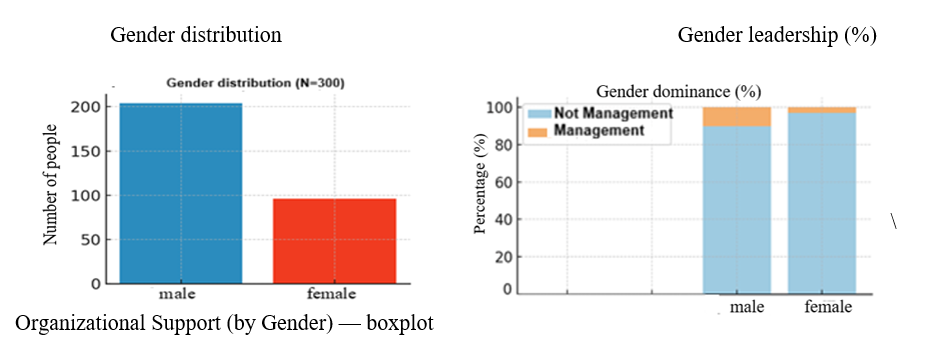
Table 3.
Logistic Regression — Odds Ratios (95% CI)
| Var | years_exp | org_support | career_perc | leadership_scale |
| years_exp | 1.0 | D0.055 | 0.049 | 0.019 |
| org_support | 0.055 | 1.0 | -0.021 | 0.059 |
| career_perc | 0.049 | -0.021 | 1.0 | -0.007 |
| leadership_scale | 0.019 | 0.059 | -0.007 | 1.0 |
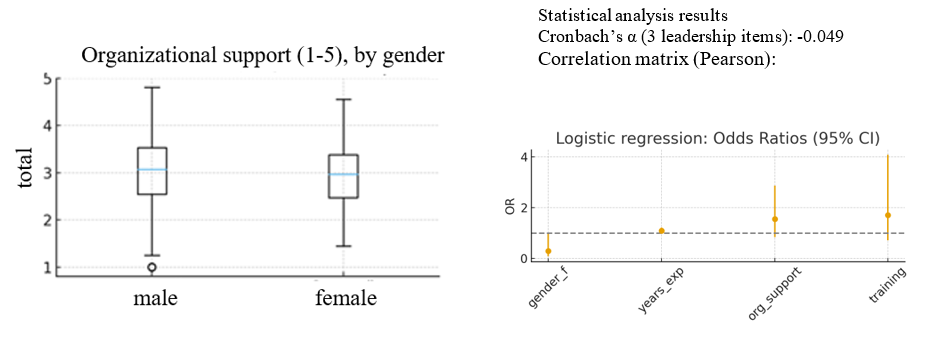
Table 4.
Logistic regression results (dependent = leadership)
| Variable | Coef | Std.Err | Z | P>|z| | OR (expcoef) |
| Intercept | -4.509 | 1.160 | -3.887 | 0.0001 | 0.011 |
| gender_f | -1.239 | 0.636 | -1.949 | 0.0513 | 0.290 |
| years_exp | 0.091 | 0.055 | 1.644 | 0.1001 | 1.095 |
| org_support | 0.440 | 0.313 | 1.407 | 0.1594 | 1.553 |
| Training | 0.536 | 0.445 | 1.202 | 0.2292 | 1.709 |
Table 5.
Odds ratios with 95% CI:
| Variable | OR | 2.5% | 97.5% | p-value |
| Intercept | 0.011 | 0.0011 | 0.1069 | 0.0001 |
| gender_f | 0.2897 | 0.0833 | 1.0069 | 0.0513 |
| years_exp | 1.0948 | 0.9828 | 1.2195 | 0.1001 |
| org_support | 1.5532 | 0.8412 | 2.868 | 0.1594 |
| training | 1.7085 | 0.7136 | 4.0905 | 0.2292 |
From a theoretical perspective, the results of the study are consistent with Kanter’s (1977) “glass ceiling” theory and Bourdieu’s “field of power” concept. In other words, it is clear that organizational culture and power structures create invisible limits to the career advancement of female employees. The results of logistic regression show that gender (female) reduces the likelihood of reaching management positions (OR<1). Organizational support and training can increase the likelihood of reaching management positions, but systematic measures are needed at the policy level.
On the other hand, 25% of the managers surveyed said that “in recent years, awareness of gender policy has increased, and training and events have become more regular,” indicating that positive changes are beginning to be made in the organization’s policy reform and management culture.
Therefore, while the gender policy has been implemented at Erdenet Plant, more in-depth reforms are needed at the system level, including equal opportunities, flexible work environments, and leadership support.
In the future, Erdenet Factory needs to pay attention to the following issues to ensure gender equality:
- Establish a gender policy implementation evaluation system. It is necessary to implement a measurable evaluation system that analyzes the organization’s annual internal audit and human resource reports by gender indicators. This will create conditions for objectively measuring the effectiveness of policy implementation.
- Increase the participation of female employees at management level. Introducing leadership development programs and mentorship systems for female employees will increase equal opportunities for career advancement.
- Regularize gender education and cultural training. Regularly incorporating gender-sensitive training into human resource policies can change employee attitudes and organizational culture.
- Introduce flexible working hours. Promoting flexible working arrangements and remote working to achieve a work-life balance will increase female employee participation and improve productivity.
- Incorporate gender sensitivity into organizational culture. Changing management approaches and systematically conducting gender-sensitive management training will ensure policy implementation.
In general, the implementation of the gender policy of the Erdenet Plant SOE is a pillar of the sustainable development of the organization, but to increase the effectiveness of the policy, management support, cultural change, and organizational-level monitoring mechanisms are essential. Such policy reforms are strategically important not only for supporting gender equality, but also for improving the quality of organizational productivity, innovation, and social responsibility.
CONCLUSION
- In conclusion, gender equality in industrial workplaces constitutes not only a dimension of corporate social responsibility but also a fundamental prerequisite for organizational efficiency, occupational safety, and sustainable development. Therefore, systematic planning, implementation, and evaluation of gender equality measures should be regarded as an integral component of modern industrial management.
- The purpose of this study was to determine the level of implementation of gender equality in the workplace of “Erdenet Plant” SOE and to analyze the impact of organizational culture, employee attitudes, and policies. According to the results of the study, gender policies are implemented to a certain extent, but practical approaches, equal opportunities for career advancement, and internal cultural reforms of the organization are insufficient.
- The quantitative results of the study show that although women make up 32% of the organization’s total employees, only 1% work at the decision-making level, indicating a serious gender gap. This is consistent with Kanter’s (1977) “glass ceiling” theory and Bourdieu’s (1991) “field of power” ideas, indicating that the power structure and culture of the organization create gender differences.
- The qualitative research findings indicate that female employees expressed negative views about career advancement, indicating a lack of gender sensitivity in the organizational culture and evaluation system.
- The majority of respondents (82%) believed that women have higher leadership potential, which confirms that the gender gap is not a matter of ability, but rather an environmental, policy, and cultural issue. Therefore, internal organizational policies, training, and cultural support play a key role in increasing women’s participation.
- The fact that Erdenet Plant has made some changes to its gender policy and internal regulations and initiated gender-sensitive training starting in 2024 is a positive trend. However, this needs to be implemented at the system level and reflected in the organization’s strategic planning.
- The findings are consistent with the findings of international organizations such as UN Women (2025) and the World Bank (2024), which indicate that while progress has been made in implementing gender policies in the mining sector, the actual impact is insufficient. This highlights the need to focus on mechanisms to evaluate policy implementation, support at the management level, and organizational culture reform.
References
1. Kanter, R.M. (1977). Men and Women of the Corporation.
2. Bourdieu, P. (1991). Language and Symbolic Power. Harvard University Press.
3. Нарантуяа, Х. (2020). Уул уурхайн байгууллагын жендэрийн бодлогын хэрэгжилт. Эрдэм шинжилгээний бичиг, №3.
4. I Б.Долгорсүрэн (2022). “Байгууллагын жендэрийн бодлогын хэрэгжилт ба үр нөлөө.” Нийгмийн судлалын сэтгүүл, №4.
5. IISD (2022). Women — Mine of the Future: Mongolia.
6. arXiv (2024). Digital finance, Bargaining Power and Gender Wage Gap.
7. MDPI (2025). Inclusion of Women in the Mining Sector.
8. Эрдэнэт үйлдвэр ТӨҮГ. (2024). Хүний нөөцийн тайлан.