
Microbial fuel cell: investigation of an innovative dual-purpose system
In the context of the global search for sustainable energy alternatives and escalating environmental challenges, this research represents a significant step into the future of biotechnology through the development of Microbial Fuel Cells (MFCs). The study is built upon the synergy of microbiology and electrochemistry, proposing an innovative approach to creating closed-loop systems where organic waste is transformed from a pollutant into a valuable energy resource. The innovation of the project lies in the implementation of the "double benefit" concept: profound biological wastewater treatment combined with the simultaneous generation of "green" electricity without external energy consumption.
The experimental phase is characterized by a high level of technical depth: we designed and tested a dual-chamber MFC prototype using accessible materials, highlighting the potential for widespread implementation of decentralized treatment systems. The rigor of the study is evidenced by a five-day monitoring of the microbial consortium's metabolic activity, establishing a direct correlation between bacterial growth phases and electrochemical dynamics. The results demonstrated not only the generation of stable power sufficient for autonomous monitoring systems but also exceptional bioremediation efficiency, resulting in the complete mineralization of the organic substrate and visible clarification of the medium.
While this research holds particular significance for preserving the unique ecosystem of the Baikal region, its potential extends far beyond local applications. This study serves as a vital contribution to the global circular economy and bioenergetics. Harnessing microbial potential to protect natural resources and create autonomous energy sources is a definitive step toward global sustainability and environmental engineering of the future, opening newhorizons for a cleaner, self-sufficient world.
Microbial fuel cells (MFCs), bioelectricity generation, wastewater bioremediation, exoelectrogens, short-circuit current, biochemical oxygen demand (BOD), cost-effective materials, green energy recovery.
Introduction
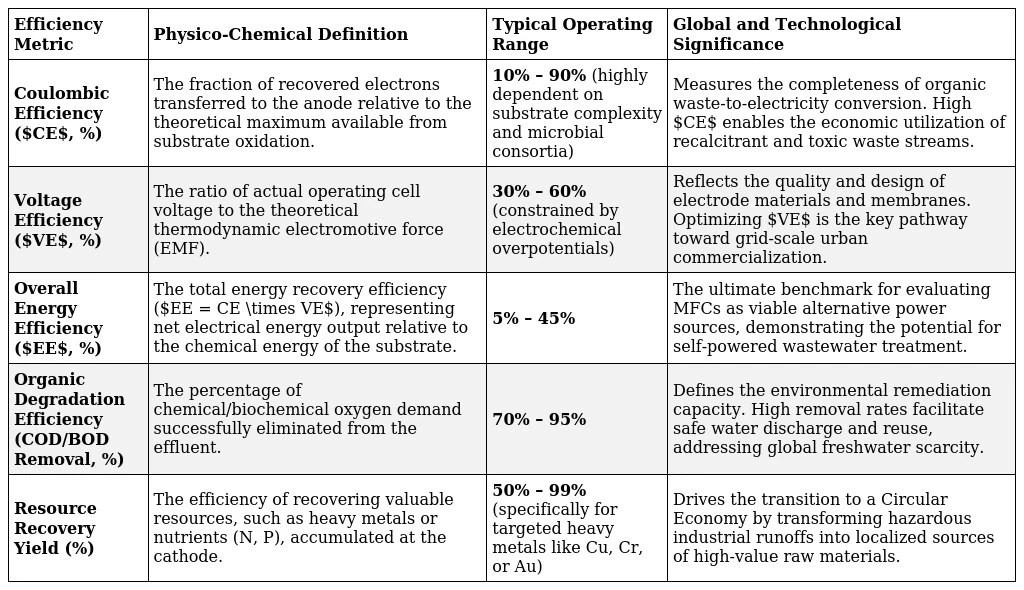
In the face of the contemporary global energy crisis and intensifying environmental degradation, developing ecologically benign renewable energy technologies represents a fundamental challenge for scientific and technological progress. Conventional wastewater treatment plants are characterized by high energy intensity and substantial operational costs. However, the organic pollutants in wastewater represent a valuable, latent reservoir of chemical energy. An elegant alternative to classical methods is represented by microbial fuel cell (MFC) technology, which implements a synergistic paradigm: concurrent bioremediation of effluents and direct bioelectricity generation. Unlike abiotic fuel cells, MFCs operate under ambient environmental conditions, obviate the need for expensive noble-metal catalysts, and utilize organic waste as a renewable substrate. The scientific novelty of this study lies in the design, fabrication, and validation of an economically viable MFC configuration capable of achieving high pollutant degradation rates while maintaining stable electrochemical performance [Table 1].
It is hypothesized that coupling the anaerobic oxidation of organic substrates by exoelectrogenic microorganisms within a scalable MFC architecture can yield sufficient electrical power to support the autonomous operation of low-power, wireless telemetric sensors for environmental monitoring.
The objective of this work is to comprehensively evaluate the electrochemical performanceand treatment efficiency of a fabricated, cost-effective MFC prototype utilizing accessible structural materials under organic load.
Research Tasks:
- Perform a systematic literature review on the mechanisms of extracellular electron transfer (EET) and the configurations of bioelectrochemical systems;
- Design and assemble a laboratory-scale MFC prototype, optimizing electrode geometry and selecting an appropriate membrane separator;
- Conduct a physicochemical analysis of the raw wastewater to establish baseline parameters of chemical oxygen demand (COD), turbidity, and electrical conductivity;
- Initiate the bioelectrochemical system and perform continuous monitoring of its current-voltage characteristics (including open-circuit voltage, short-circuit current, and power density) using a digital multimeter;
- Evaluate the degradation kinetics of organic pollutants by quantitatively comparing pre- and post-treatment COD levels;
- Establish the correlation between substrate concentration and MFC power output to assess the scalability and practical feasibility of the technology.
Table 1
Key Operational and Bioremediation Metrics of the MFC
Results&conclusion.
This research successfully demonstrates the viability of cost-effective microbial fuel cell (MFC) technology as a synergistic solution for concurrent bioenergy recovery and deep wastewater remediation. By validating stable electrical outputs alongside significant effluent clarification using accessible materials, the study confirms that bioelectrochemical systems can effectively bridge the gap between waste management and sustainable power generation. The identified prospects for future implementation—including electrode optimization, reduction of internal resistance, and transition to continuous-flow architectures—highlight a clear pathway toward transforming conventional treatment facilities into decentralized, self-powered bio-refineries. Ultimately, this study provides a foundational framework for the development of autonomous environmental monitoring systems and contributes significantly to the global transition toward a circular, carbon-neutral economy.
References
1. Patent No. 2833628 C1 H01M 8/16, Russian Federation, Microbial Fuel Cell: No. 2024123330; filed 13.08.2024; published 28.01.2025 / Safronova M. E., Bulychev V. V., Ilyin V. K., Kusacheva S. A., Kalmykov V. V., Loginova A. Yu., Grossman M. F., Golubina S. A., Ponomarev A. I.
2. Utility Model Patent No. 162308, Russian Federation, IPC H01M 8/16. Bioelectrochemical Fuel Cell: No. 2015141501; filed 29.09.2015; published 10.06.2016 / Paperny V. L., Borokhoev N. D., Stom D. E., Tolstoy M. Yu., Saksonsov M. N., Koshelev N. A., Shipitsyn N. V.; applicant: Irkutsk State University.
3. Patent No. 209073 H01M 8/16, Russian Federation, Microbial Fuel Cell: No. 2021117491; filed 16.06.2021; published 01.02.2022 / Maseykin N. V., Maseykina A. A., Stepanenko I. S.
4. Research paper on Industrial Biotechnology by Denis Leonidovich Dubovets.
5. Book “Microbial Fuel Cells” by Bruce Logan;
6. Textbook “Microbial Fuel Cells” by S. V. Alferov and T. A. Kuznetsova.
7. https://www.computerra.ru/213622/uluchshennyie-mikrobnyie-toplivnyie-elem
8. https://www.sbras.info/articles/science/mikrobnye-toplivnye-elementy-chistaya-energiya
9. https://cyberleninka.ru/article/n/mikrobnyy-toplivnyy-element-kak-istochnik-alternativnoy-energetiki
10. https://patents.google.com/patent/RU145009U1/ru
11. https://www.mathnet.ru/links/ca5aed4e24bb10823d6d0b2f189a8527/jtf5065.pdf