
Experience and prospects of low-potential wastewater heat utilization
Опыт и перспективы утилизации низкопотенциального тепла сточных вод
В статье анализируется потенциал утилизации низкопотенциального тепла сточных вод для повышения энергоэффективности систем теплоснабжения промышленных и гражданских объектов. Рассмотрены принципы работы теплонасосных установок, типы теплообменного оборудования и их влияние на гидравлический режим канализационных сетей. На основе зарубежного опыта и российских реалий оценены технико-экономические показатели внедрения технологий рекуперации. Выявлены ключевые барьеры массового распространения технологии, включая риски снижения температуры стоков для очистных сооружений, и предложены пути их минимизации.
The article analyzes the potential of utilization of low-potential waste water heat to improve the energy efficiency of heat supply systems for industrial and civil facilities. The principles of operation of heat pump installations, types of heat exchange equipment and their influence on the hydraulic regime of sewer networks are considered. Based on foreign experience and Russian realities, the technical and economic indicators of the introduction of recovery technologies are evaluated. Key barriers to the mass dissemination of the technology have been identified, including the risks of lowering wastewater temperatures for wastewater treatment plants, and ways to minimize them have been proposed.
утилизация тепла, сточные воды, тепловой насос, энергоэффективность, рекуперация энергии, низкотемпературное тепло, системы теплоснабжения, экологическая безопасность.
heat recovery, waste water, heat pump, energy efficiency, energy recovery, low-temperature heat, heat supply systems, environmental safety.
Introduction
Industrial, civil and public facilities are places of concentration of secondary sources of heat generation, the energy of which can be effectively used with the help of specialized equipment, in particular heat pumping units (HPU). Currently, there is practically no comprehensive information on determining the energy efficiency of heat supply systems using HPUs that use wastewater as a source of low-potential energy, which makes it difficult to replicate successful cases on a large scale.
The rapid and successful development of any country requires a huge potential in energy resources. The main consumers are industrial enterprises and large production associations, which require constant consumption of heat and electric energy. These energy resources are either produced on the territory of the state or purchased from neighboring countries. However, the unequivocal fact remains that the production of heat and electricity traditionally requires burnt fuels such as oil, gas, and coal [1]. The growth of the global economy is inextricably linked with the development of industry, which leads to an increase in the demand of states for fuel and, as a result, to an increasing rate of its production.
Today, slightly less than half (about 38-40%) of energy resources are spent on heat supply, heating, ventilation, air conditioning and hot water supply to industrial, public and civil facilities. It is important to note that saving 1% of the energy consumed by internal systems will reduce the use of non-renewable energy sources and save millions of tons of conventional fuel [2].
In recent decades, Russia has seen a consistently high proportion of thermal power plants that cause great harm to the environment in the overall energy balance of the country. This, together with the desire for more efficient fuel consumption, has led to favorable conditions for exploring the possibility of using thermal installations to generate heat from wastewater.
To date, there is very little use of wastewater-powered thermal installations in Russia. Experimental attempts at such installations and their introduction into urban sewage systems were carried out back in Soviet times, after the collapse of which this technology was forgotten for decades. Today, the installation of heat pumps using wastewater as a source is carried out by several companies in cities such as Moscow and St. Petersburg. However, company representatives talk about an individual approach to each facility, which makes it difficult to implement such installations everywhere.
Since alternative energy sources are becoming increasingly popular in the modern world, especially heat pumps that use wastewater as the main raw material (a source of low-potential heat with a temperature of usually 10-25 °C), the use of TNW throughout the life cycle of buildings is becoming relevant. Research shows not only economic benefits, but also a real reduction in greenhouse gas emissions.
Heat pumping units operate, as a rule, on the principle of a steam compression heat engine based on the Carnot cycle. The principle of heat generation is based on the phase change of the refrigerant state from boiling to condensation. The energy conversion coefficient for modern wastewater treatment plants can reach values from 3 to 5, which means receiving 3-5 kW of thermal energy for every 1 kW of electricity consumed [3].
There are several models of heat exchangers for the extraction of heat energy from wastewater:
— Plate heat exchangers. They require pre-treatment of wastewater from large fractions.
— Pipe-in-pipe heat exchangers. They are often used for low heat transfer costs. They are series-connected pipes of different diameters. They provide high speeds of the coolant, but their installation requires a temporary suspension of the company’s operation to connect to the network.
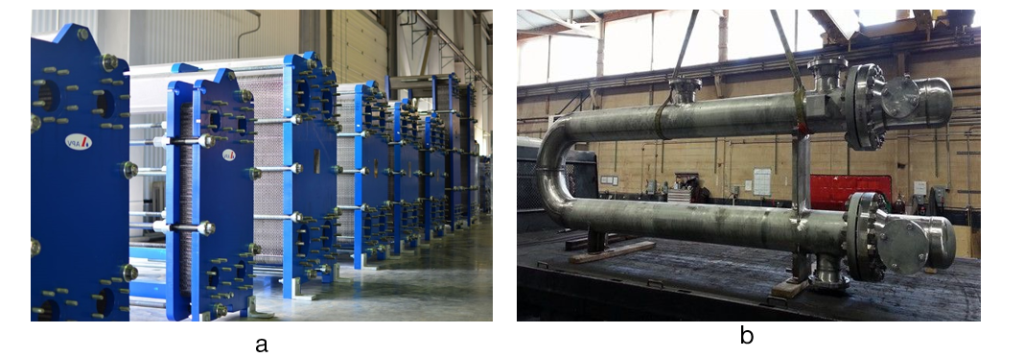
Figure 1. Heat exchangers: a – plate type; b – pipe–in-pipe type;
The experience of implementing similar projects abroad demonstrates high efficiency. The DHC (district heating and cooling) system was tested in Japan, in one of the Tokyo districts (for example, the Odaiba project). The heat of untreated wastewater was used in this installation. The system reduces energy consumption by 20%, and CO2 and NOx emissions by 40% and 37%, respectively [4]. This project was unique because untreated wastewater was used for work, which made it possible to further use such installations not only in sewage treatment plants, but also directly in sewer networks. The station has three heat pumps, two of which operate continuously, and the third (peak) is switched on when there is a simultaneous need for cold and hot water supply.
In Europe, similar systems are actively developing in Switzerland (Zurich) and Norway (Oslo), where wastewater heat is used to heat residential areas and even greenhouses.
In the course of experiments conducted by a number of scientists, it was revealed that the most rational way to generate energy would be to install heat pumps directly close to the source of wastewater discharge. Beyond the critical flow, the actual efficiency of the plants decreases, which forces the installation of more heat exchangers, which negatively affects profitability.
With the growing interest in heat recovery plants, it is important to assess the potential on a system-wide scale. Of particular concern is the negative impact on wastewater disposal, mainly nitrification (the process of ammonia oxidation), due to a decrease in wastewater temperature caused by heat recovery upstream. Biological purification requires maintaining a temperature of at least 10-12 °C, so the depth of heat extraction must be strictly regulated [5].
Improving energy efficiency has long been promoted as a way to increase productivity and sustainability in society. The benefits range from local (energy availability, improved health) to sectoral (industrial productivity, reduced environmental damage).
However, high capital expenditure (CAPEX) on equipment often hinders implementation. The payback period for wastewater heat recovery projects in Russian conditions varies from 3 to 7 years, depending on the tariffs for thermal energy and the operating mode of the facility. A promising financing mechanism is the introduction of energy service contracts, when an investor invests in equipment, and returns them due to the savings achieved.
The current energy situation requires the search for new, more efficient ways to use energy resources. Industrial, civil and public facilities have significant potential for heat energy recovery. The use of wastewater as a source of low-potential heat is particularly promising.
Despite the availability of technical solutions and the positive experience of implementing similar projects abroad (especially in Japan and the EU), this technology has not yet been widely used in Russia. The main barriers remain high initial costs, the lack of unified standards for embedding in sewer networks, and the risks of affecting biological wastewater treatment.
Of particular importance is the placement of heat exchange equipment as close as possible to wastewater discharge sources, taking into account the critical water consumption. Reducing the temperature of wastewater should not violate the technological regulations of wastewater treatment plants.
Conclusion
The use of thermal energy from wastewater is an important reserve for improving energy efficiency and environmental friendliness of heat supply systems. At the same time, further work is required to adapt existing technologies to Russian conditions, develop standard design solutions and create cost-effective implementation models for mass use. The development of this area can make a significant contribution to solving the problems of energy conservation and reducing the negative impact on the environment, in line with global trends in decarbonization of the economy.
References
1. Glukhova, P. E. Waste water heat utilization by a heat pump / P. E. Glukhova // Tinchurin Readings - 2025 "Energy and Digital Transformation" : Proceedings of the International Youth Scientific Conference. In 4 volumes, Kazan, April 23-25, 2025. Kazan: Kazan State Power Engineering University, 2025. pp. 241-243.
2. Kunitsky, V. A. Determination of the efficiency of local waste water heat utilization based on a heat exchanger / V. A. Kunitsky, S. V. Lukin // Izvestiya vysshikh uchebnykh zavedeniy. Energy problems. - 2024. – Vol. 26, No. 4. – pp. 136-149.
3. Khamitova, A.M. Possibilities of using heat pumps in Russia / A.M. Khamitova, A.V. Stavitsky // Agrarian science in the context of time : Proceedings of the LX international scientific and practical conference of students, postgraduates and young scientists – Tyumen: State Agrarian University of the Northern Urals, 2025. – pp. 95-99.
4. Kondratiev, A. E. The use of a heat pump for heating an individual home / A. E. Kondratiev // Instrumentation and automated electric drive in the fuel and energy complex and housing and communal services : Proceedings of the VII National Scientific and Practical Conference. Kazan: Kazan State Power Engineering University, 2022. pp. 705-707.
5. Kunitsky, V. A. Characteristics of a heat exchanger for local utilization of wastewater heat under various operating conditions / V. A. Kunitsky, S. V. Lukin // News of higher educational institutions. Energy problems. – 2024. – Vol. 26, No. 2. – pp. 176-186.