
Using artificial intelligence technologies in designing reconstructed garments
This article examines the concepts of artificial intelligence and its use in preservation, and rethinking the historical heritage of the Lower Don region of the Russian Federation, by means of designing reconstructions of garments, as an object of visual culture. A historical description of the costume of the Scythians of the 3rd-5th centuries BC is given. As a result of research, sketches of experimental prototype images of model solutions of Scythian costumes of the 3rd-5th centuries BC were developed, in the author's reading and using artificial intelligence.
artificial intelligence, Russian Federation, culture, Scythian costume, design, reconstruction of a garment.
The development of technology, technological progress over the years has radically changed the way of life of modern people. Incredible new tools and resources have made previously unavailable knowledge. Technological advances contribute to the dissemination of knowledge and subsequent progress, being the driving force behind a massive scientific and cognitive revolution aimed at improving the quality of human life through the dissemination of valuable innovations. This type of technology includes: robotics, additive technologies, artificial intelligence and much more.
Artificial intelligence (AI) is used in various fields of human activity. It helps to automate processes, systematize work, expand human capabilities, see the final result of research in the process of development [1].
The term «artificial intelligence» was coined by John McCarthy in 1956 at a conference at Stanford University. «Artificial intelligence is the science and engineering activity of creating intelligent machines and programs» [2]. Initially, AI was closer to mathematics than to creativity and aesthetics.Recently, AI has had the greatest impact on the field of fashion, design, design of new clothing products. Intelligent algorithms not only calculate and process large amounts of data, but also predict trends and create ready-made visual images [3].
In the modern context, the role and place of AI in human activity should be clearly distinguished. On the one hand, it is a tool that allows you to offer faster and more accurate solutions [4]. On the other hand, neural networks become «shadow» performers who completely perform work instead of a person. Whether AI will be an innovator of development or a threat to the author’s identity in design, this requires an analysis of the benefits and risks of its use in design processes.
The introduction of artificial intelligence in the fashion industry, namely in the reconstruction of historical samples, brings a number of significant advantages. It allows you to increase the speed of solving tasks, while ensuring high accuracy [2]. In the creative process, AI helps to reduce the time spent on searching for fabrics, textures, and choosing a decorative solution (finish). 3D models created using AI, based on the designer’s sketch, allow you to create a realistic model for virtual fitting.
Despite the advantages, the use of AI entails a number of serious risks. One of the main problems is the reliability of information transmission based on the data of existing works [4].
AI often creates distorted and inoperable models. Such generated images are beautiful, but they cannot be implemented without human refinement (for example, dresses without seams, errors in the interpretation of textures, fabric «hanging in the air,» or inharmonious compounds of materials devoid of logic). The above effects are not acceptable in reconstructed suits.
The use of algorithms jeopardizes cultural values and traditional creativity, which in the future can lead to inaccurate reading of the cultural code of any ethnic group.
In the process of developing the author’s collection, artificial intelligence was applied and analog and hybrid design methods were implemented. The example of working with the collection shows exactly how you can use the capabilities of modern technologies.
A feature of the modern period of the historical development of Russian society is the increased interest and great importance of national identity and self-awareness of people as part of their own culture in the world community. The key decree of the President of the Russian Federation for 2026 was the announcement of it as the «Year of the Unity of the Peoples of Russia» (Decree No. 78861 of 25.12.2025) in order to strengthen interethnic harmony. [5]
The Russian Federation is a multinational people united by a common destiny on their land, affirming human rights and freedoms, civil peace and harmony, preserving the historically established state unity, proceeding from the generally recognized principles of equal rights and self-determination of peoples, honoring the memory of ancestors who passed on to us love and respect for the Fatherland. [5]
The difficulty of preserving culture in an authentic form and transmitting them to future generations with maximum preservation is determined by the inevitable problems associated with the loss of many cultural objects caused by a long period of time. As a result, restoration and reconstruction technologies are of great importance, they are important for popularizing and drawing attention to cultural heritage sites. [6].
Reconstruction technologies contribute to an increase in possible sites for specialized events (exhibitions in museums, design of art spaces) for implementation with the attraction of people to disclose the content of cultural heritage objects. [7] This requires an increase in the number of objects of observation themselves, which, of course, is already beyond the capabilities of museum restoration technologies and is more related to reconstruction technologies.
As a geographical location, as an important segment among the wide variety of cultural heritage of Russia, there is a segment of territorial localization of attributes of historical eras and their characteristics in the region of the Lower Don of the Russian Federation [5]. The cultural heritage of the Lower Don in the form of various costume items represents a unique segment of subject design that requires special attention.
The creation of graphic design objects for the manufacture of model solutions for a historical costume on the example of ethnocultural societies of the Lower Don is based on a basic understanding of the location and historical features of the costume culture formed in it.
Research «concepts «Lower Don» includes the flow of the Don River from Kalach to the Taganrog Bay.» It was the natural conditions of the Lower Don that largely determined the history of human settlement in ancient times. For thousands of years, geographically connected with the significant Don River, which became the center of attraction for the foundation and development of centers of trade and interaction between representatives of the Great Steppe and the Mediterranean. Important for the location of the Lower Don is that the Sea of Azov is located nearby. [3]
The basis for the development of a reconstructed version of sketches using AI, and later on the implementation of models of Scythian costumes living on the territory of the Lower Don, is the initial information of historical significance. As noted in many studies, the peculiarity of the Don territories and the life of the people living in it is that intercultural and interethnic ties had on the general part of the placement. Scythians were selected as the studied ethnic group.
According to one source, the Scythians are the common name for Iranian-speaking tribes related to language and culture, the origin of which has not been fully clarified. [8] Other studies claim that the Scythians are the Greek word with which the Hellenes denoted nomadic peoples living in the Black Sea between the currents of the Don and Danube rivers. The Scythians themselves called themselves Saki. [9]
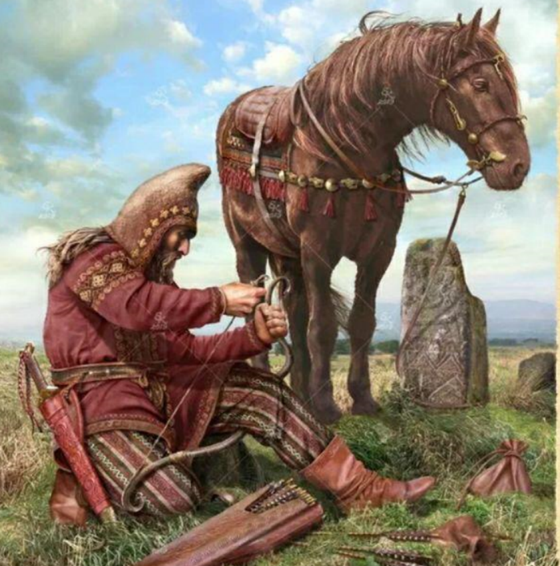
The clothes of the Scythians became known from the excavations of the Scythian burial mounds. Ancient Scythians wore clothes made of leather, which were sewn with thin straps or strong threads, made of woven and felt sheep wool. Clothing was made by a woman and slaves. The men’s suit consisted of a shirt, pants and a long-sleeved jacket. Pants-anaxirids (patterned pants) were embroidered or metal overlays, leather jackets of various lengths. From the front, the jacket was scented and fastened with a clasp or tied with a leather belt. Such a jacket can be considered the oldest known form of caftan. On the sleeves on top was embroidery (similar to the robes of the Byzantine emperors or Iranian-Mongolian clothes). Under the jacket was dressed shirt-kirbasia. Shoes are wide, leather half-shoes. Hats for men are pointed, cone-shaped leather or felt hats covering the back of the head and ears.
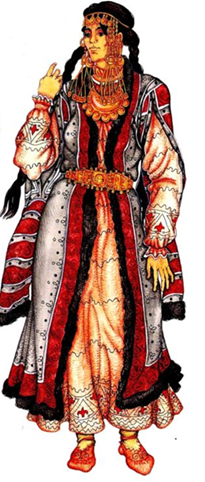
Little is known about the clothes of ancient Scythian women, the costume consisted of a dress and a top piece. In general, it was wider and richer decorated than men’s clothes. The female costume was supplemented with jewelry that was actively borrowed from adjacent Greek colonies: earrings, bracelets, rings, diadem, leg bracelets, belts [10]
If we take into account the tasks and terms of reference of this project, then sewing products should be divided by seasonal and target characteristics and the filter of the applicable assortment should be preserved, taking into account everyday or ceremonial use.
In general, the types of finishes and ergonomic solutions for Scythian clothing are determined by their conditions of use and could consist of the upper lower part (shoulder and waist) which, with further detailing of various products, attributes, shoes, accessories, items and many other components of the costume images, were synthesized as part of a creative phased process.
Images of open sources of samples of the suit of Scythians of the III-V centuries BC are represented by a female suit in Figure 1, a, a male suit in Figure 1, b reflect the general shape of the clothes of the period under consideration, as well as the specifics of the image when it is completed in a suit, taking into account possible representations in color scheme, details of decoration.
 |
 |
| (а) | (б) |
Figure 1 — Samples of Scythian clothing (a — historically recreated drawings of a female costume [9], b — historically recreated drawings of a male costume)
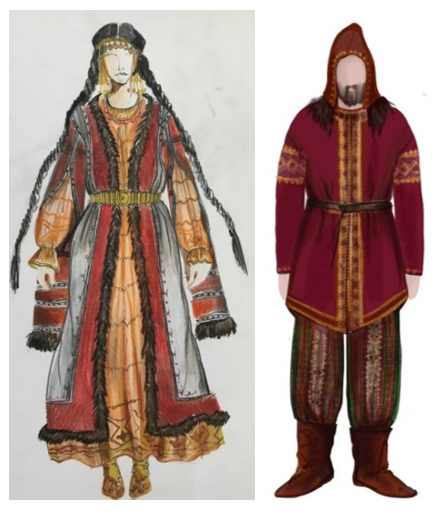
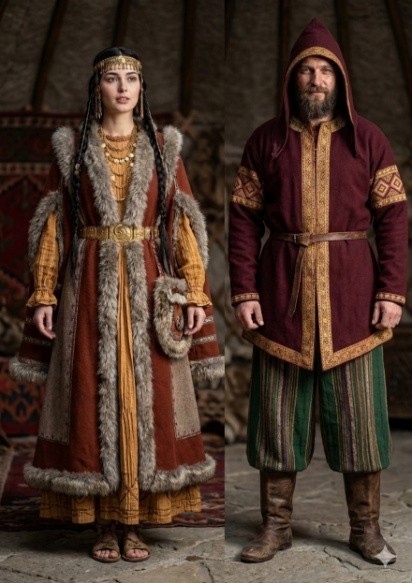
As a result of research, analytical and creative searches, sketches of experimental prototype images of model solutions of Scythian costumes of the 3rd-5th centuries BC were developed, presented in Figure 2, a-author’s sketch made in mixed graphics, in Figure 2, b-costume complex made using AI.
 |
 |
| а) | б) |
Figure 2 — Copies of the costumes of the Scythians of the III-V centuries BC,
(a-suit complex made using mixed equipment, b-suit complex made using AI)
Based on the above comparison, we can say that AI in fashion (designing garments) is a tool and co-author, but it will never replace the human mind, imagination. In this work, AI acts as a tool for virtual visualization of a sketch created by the author on the basis of comprehensive work with representatives of the museum community.
Research and development of sketches was carried out within the framework of the project: «Museum Mirror of History: Diversity of Historical Costume in Ethnocultural Societies of the Lower Don» with the support of the Vladimir Potanin Charitable Foundation, the Creative Museum competition, the Museum Without Borders program on the basis of the Kamensky Museum, within the framework of grant No. GMKM-003/24 of 25.03.2024 [11].
Within the framework of a large-scale cultural project, the reconstruction of the exposition costume of the Scythians of the 3rd-5th centuries was successfully introduced. BC as a basis for a deep study of the heritage of the population of the Lower Don. The costumes are recreated with the maximum degree of historical authenticity, reflecting the features of the cut, ornament, shape and texture of the garment. The experience of forming an exposition costume demonstrates the richness and diversity of the cultural heritage of the Lower Don, allowing viewers to touch history and feel the connection of times.
People and their cultures are constantly evolving. There is no denying that the technological advances we are currently seeing are astonishing. The use of AI technology in research aimed at reconstructing costume forms opens up unprecedented opportunities associated with the study and reconstruction of a historical costume. Digitized images of paintings, engravings, archaeological artifacts describing clothes can be used as an analytical base. AI is able to recognize a coloristic solution, identify the cut, fabric structure, finish characteristic of a garment of certain ethnic groups. AI is able to transform the process of analytical work, accelerating and deepening the understanding of costume details that could previously go unnoticed, is able to quickly help with the visualization of the final product (costume pair). Experience with AI confirms that such technologies can visualize creative sketches in realism and speed up the process of finding materials and colors to create reconstructed garments of a historical costume.
References
1. Balanov, A.N. Artificial intelligence. Understanding, application and prospects: a textbook for universities/A.N. Balanov. - 3rd ed., Erased - St. Petersburg: Doe, 2026. - 312 p. - Text: immediate. ISBN 978-5-507-55902-2 Lan. Reader (Accessed on 28.02.2026)
2. Emtsev, D.I. ARTIFICIAL INTELLIGENCE, PROS AND CONS. - Text: electronic//CyberLeninka. – URL: https://cyberleninka.ru/article/n/iskusstvennyy-intellekt-plyusy-i-minusy/viewer (Дата обращения 28.02.2026)
3. Demidova, M.D., Rykova E.S. Application of modern artificial intelligence technologies in the fashion industry. - Text: electronic//CyberLeninka. – URL: https://cyberleninka.ru/article/n/primenenie-sovremennyh-tehnologiy-iskusstvennogo-intellekta-v-industrii-mody/viewer (Дата обращения 28.02.2026)
4. Shpak, A.A., Koptseva M.S. Artificial intelligence in the art world: copyright. - Text: electronic//CyberLeninka. – URL: https://cyberleninka.ru/article/n/iskusstvennyy-intellekt-v-mire-iskusstva-avtorskoe-pravo/viewer (Дата обращения 28.02.2026)
5. Decree on the Year of Unity of the Peoples of Russia.– URL:
http://kremlin.ru/acts/news/78861(Дата обращения 23.04.2026)
6. Archeology of the Lower Don/Executive Editor, Doctor of History, Professor A.V. Kiyashko .//Rostov-on-Don: Southern Federal University. - 2013. - 64 s.
7. Nizhnedonskaya Cossack woman in an everyday suit with an apron "zaveska," 18 in.. - 2022 - URL: https://businka.org/uploads/images/00/ 02/48/2015/06/13/c95589.jpg (accessed date 19.01.2026).
8. Archeology opened - 2026 - URL: https ://xn--80aajhqhktebqcvc2c9e6cj.xn--p1ai/arch-cultures/( date of reference 15.04.2026).
9. The real story. Scythians. - 2017 - URL: https://hystory.mediasole.ru/skify (date of contact 15.04.2026).
10. Smirnov A.P. Scythians .//M.: 1966. 200 s
11. Mitrokhina T.A., Cherunova I.V. Preparation of the design of the exposition costume with elements of reconstruction of the forms and textures of sewing products//Sat-to works of the 11th scientific-prakt. conf. with inter. participation "Problems of the development of modern society" (January 20-21, 2026) - Kursk: KROO "VEO of Russia," 2026 (RSCI).